


The Visual Sciences Training Program
The Visual Sciences Training Program (VSTP) is comprised of a multi-disciplinary vision sciences research community at Case Western Reserve University. This program is funded by a T32 Training Grant from the National Eye Institute (NEI) of the National Institutes of Health (NIH).
Interactions among faculty, postdoctoral fellows and graduate students in the VSTP and the broader research community at Case Western Reserve and University Hospitals Case Medical Center create an excellent training environment in vision science research. View the VSTP trainee handbook.
Students with disabilities are welcome to apply to our graduate and T32 programs.
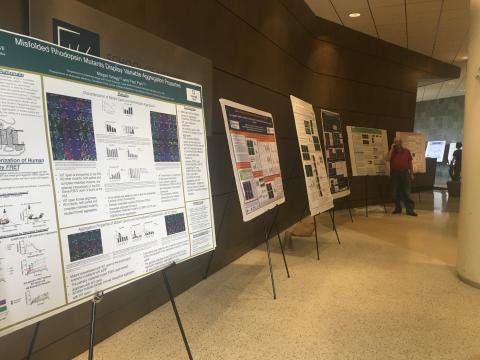
Training Faculty and Research
View a complete list of VSTP faculty.
Predoctoral Training
Predoctoral students typically apply for PhD training at Case Western Reserve through the Biomedical Scientist Training Program (BSTP), the umbrella admissions program that serves all of the PhD-granting programs at Case Western Reserve School of Medicine. Alternatively, students may apply directly to the PhD programs in the Department of Pharmacology or the Department of Neurosciences.
Applications for PhD training should be completed in the fall or early winter for admission in July, preceding the next academic year. After taking foundational core courses in cell and molecular biology and research rotations in several different laboratories, first-year PhD students will choose a research advisor and specific PhD-granting program by January.
Students who align with VSTP trainers are eligible to compete for appointment to the Visual Science Training Grant. VSTP trainees conduct research in any of the five VSTP areas of emphasis: Aging and Diabetes in the Eye, Ocular Inflammation and Infection, Phototransduction, Retinal Development and Disease, and Translational Visual Sciences.
During the first and second years of graduate education, trainees will complete coursework requirements and initiate their PhD research projects with their dissertation advisors. The third- and fourth-year students are dedicated to completing their research projects, submitting manuscripts for publication, preparing written dissertations, presenting public thesis seminars, and orally defending their work before a thesis committee that has followed their progress through the course of their studies.
Postdoctoral Training
Postdoctoral trainees are those who have already attained a PhD, MD, or MD/PhD degree at the time they are appointed to the Visual Sciences Training Program. The intent of postdoctoral training is to attract individuals from non-vision areas whose previous experience with contemporary research approaches can be applied creatively toward understanding problems in vision science, synthesizing literature and technology from different disciplines and bringing new insights to an area of interest.
Recent PhD, MD or equivalent doctoral-degree recipients perform mentored research on a full-time basis under the supervision of a faculty member approved as a VSTP trainer. The training period on the T32 grant is usually one to two years.
Research Experience Component
The strength of the VSTP is that all trainees receive departmental and research specific mentoring and benefit from the resources of the Visual Sciences Research Center. The laboratory-focused experiences collectively equip pre-doctoral and postdoctoral trainees with insight into a full range of research issues, including ocular genotype, cell/molecular biology of the visual system and structural and functional phenotypes of eye diseases.
As trainees progress toward the status of independent, NEI-funded investigators, they will be able to pose biologically and clinically relevant questions without being restricted by either discipline or methodology. All trainees participate in journal clubs, departmental seminar programs, VSRC group presentations and the annual VSRC retreat.
Current Topics in Vision Research - PHRM 432 (Spring 2020)
"Current Topics in Vision Research" is a required course for all pre-doctoral trainees in the Visual Sciences Training Program. Postdoctoral trainees of the VSTP also are encouraged to take the course for credit and will be supported by the training grant.
All other post-docs can audit the course. Vision research is an exciting and multidisciplinary area that draws on the disciplines of biochemistry, genetics, molecular biology, neuroscience, pathology, pharmacology and structural biology.
This graduate level course provides the students with broad exposure to the most recent and relevant research currently being conducted in the field. Topics typically cover a variety of diseases and fundamental biological processes occurring in the eye.
Regions of the eye that are discussed include the cornea, lens, and retina. Vision disorders discussed include age-related macular degeneration, retinal ciliopathies and diabetic retinopathy.
Instructors in the course are experts in their fields and are members of the multidisciplinary visual sciences research community here at Case Western Reserve University. Students are exposed to the experimental approaches and instrumentation currently being used in the laboratory and clinical settings.
Topics are covered by a combination of traditional lectures, demonstrations in the laboratory and the clinic, and journal club presentations.
Application Process
Initiating an Application: Students enrolled in a CWRU PhD or MD/PhD program can apply, providing they are US citizens or permanent residents.
Please submit a single PDF file with the following information:
- From the student: Cover letter, biosketch, graduate school transcript, description of proposed research project (2 pages maximum which should not be a copy of the mentor's grant proposal).
- From the mentor: Letter of recommendation and proposed training plan.
Biomedical Sciences Training Program
Medical Scientist Training Program
Questions?
Visual Sciences Training Program
Case Western Reserve University, School of Medicine
Attention: Johannes Von Lintig, PhD, jxv99@case.edu or Emily Koritz, exk533@case.edu