CASE.EDU:    HOME | DIRECTORIES | SEARCH
case western reserve university

BIOCHEMISTRY


Dr. Vernon Anderson

Professor

Pub Med:

Dr. Vernon Anderson

There are two research projects in the lab: the study of structural alterations produced by ligand binding or the association of macromolecules and the study of the chemistry of protein oxidation and reactions with the hydroxyl radical.

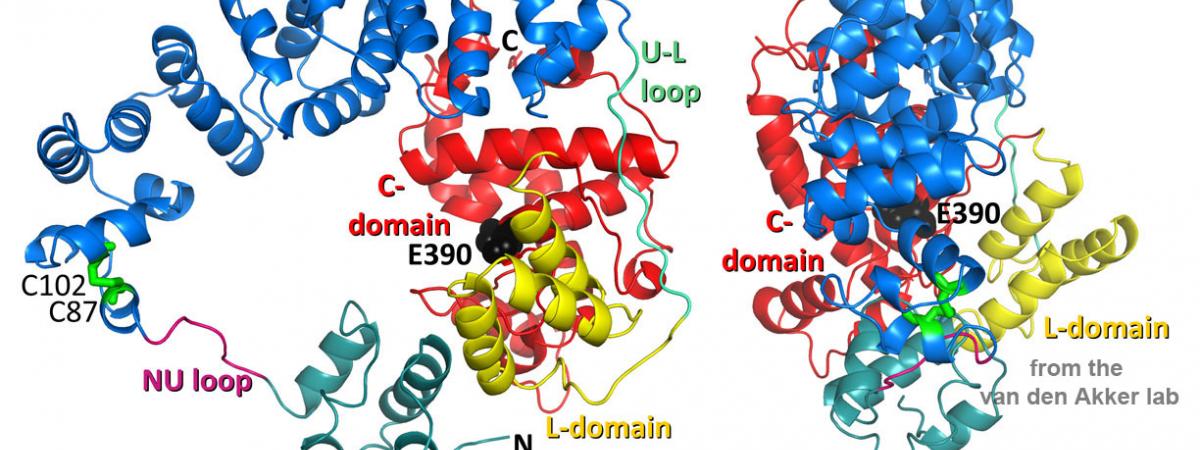
The alterations produced by ligand binding or macromolecular association are studied in the Anderson lab. The level of molecular detail varies from trying to detect and quantify the chemical activation of substrates that occurs on the level 0.1 angstrom changes in bond lengths to trying to determine which amino acid side chains are involved in intermolecular contacts. Coenzyme-A utilizing enzymes, such as enoyl-CoA hydratase, serve as model systems for understanding electronic activation when substrates bind to an enzyme active site. The hydratase has been cloned and overexpressed and the three dimensional structure determined by x-ray crystallography in collaboration with Drs. Ringe, Petsko and Bahnson. The transition state of the reaction has been determined by isotope effect studies question is how does the enzyme entice the substrate and product to resemble the transition state while bound at the active site. The results of Raman and NMR spectroscopic studies are being interpreted by quantum chemical modelling to determine the electronic structure of the bound ligand. Mycobacteria tuberculosis enzymes that use similar substrates are pharmaceutical targets since they are essential for bacterial cell wall biosynthesis, where understanding the structure of the bound substrate should aid pharmaceutical design.

For more information on enoyl-thiolester utilizing enzymes click on the CoA molecule.

The second focus of the Anderson lab is studying the chemistry of protein oxidation and reactions with hydroxyl radical. Peroxonitrous acid and radiolysis have been used to determine the solvent accessible surfaces of nucleic acids. This approach is being extended to proteins in two different fashions. The first is to use anaerobic radiolysis to effect the exchange of 2H for 1H in C-H bonds. The exchange is detected by isotope ratio mass spectrometry. The second method is to examine the oxidative products of proteins exposed to reactive oxygen radicals. This is an important aspect of the cellular damage in both ischemic reperfusion injury and as a cause of neurodegenerative diseases. The chemical nature of the damage in reperfused hearts is being studied in a collaborative project and the oxidative damage present in Alzheimers and Parkinsons disease plaques being characterized. Our approach is to use chemical and stable isotope methods to permit the detection and structural characterization of oxidatively damaged proteins by electrospray ionisation mass spectrometry.

For more information about the use of stable isotopes in characterizing proteins and protein oxidation click on the mass spectrum.

Selected References

  • Bahnson, B.J., Anderson, V.E. & Petsko, G.A., Snapshot of the mechanism of enoyl-CoA hydratase from a substrate complex crystal structure, Biochemistry, in press, 2002.

  • D'Ordine, R.L., Pawlak, J., Bahnson, B.J. & Anderson, V.E., Polarization of Cinnamoyl-CoA Substrates Bound to Enoyl-CoA Hydratase: Correlation of 13C NMR with Quantum Mechanical Calculations and Calculation of Electronic Strain Energy, Biochemistry, in press, 2002.

  • Liu, B., Wang, Y., Fillgrove, K.L. & Anderson, V.E., Triclosan inhibits human fatty acid synthase and is cytotoxic in cell culture of MCF-7 and SKBR-3 cells., Cancer Chemotherapy and Pharmacology, in press, 2002.

  • Swisher, J.F., Su, L.J., Brenowitz, M., Anderson, V.E. & Pyle, A.M., Productive Folding to the Native State by a Group II Intron Ribozyme, J. Mol. Biol., 315(3), 297, 2002.

  • Nukuna, N., Goshe, M.B. & Anderson, V.E., Sites of hydroxyl radical reaction with amino acids identified by 2H-NMR detection of induced 1H/2H exchange, J. Am. Chem. Soc., 123(6), 1208, 2001.

  • Gawlita, E., Lantz, M., Paneth, P., Bell, A., Tonge, P. & Anderson, V.E., H-bonding in alcohols is reflected in the aC-H bond strength: Variation of C-D vibrational frequency and fractionation factor, J. Am. Chem. Soc., 122(47), 11660, 2000.

  • Fillgrove, K. F., & Anderson, V. E. (2000). Orientation of CoA substrates, nicotinamide and active site functional groups in (di)enoyl-CoA reductases. Biochemistry 39, 7001-7011.

  • Goshe, M. B., Chen, Y. H. & Anderson, V. E. (2000). Identification of the sites of hydroxyl radical reaction with peptides by hydrogen/deuterium exchange: Prevalence of reactions with the side chains.  Biochemistry 39, 1761-1770.

  • Hofstein, H. A., Feng, Y., Anderson, V. E. & Tonge, P. (1999). Role of glutamate-144 and glutamate-164 in the catalytic mechanism of enoyl-CoA hydratase. Biochemistry 38, 9508-9516

  • Chen, X., Chen, Y. H. & Anderson, V. E. (1999). Isotope edited product ion assignment by a-N labeling of peptides with 2,4-dinitrofluorobenzene-h3:d3. Journal of the American Society of Mass Spectrometry 10, 448-452.

  • Chen X., Chen Y.H. & Anderson V.E. (1999). Protein Cross-Links: Universal Isolation and Characterization by Isotopic Derivatization and Electrospray Ionization Mass Spectrometry. Analytical Biochemistry 273,192-203.

  • Chen, X., Eswaran, D., Smith, M. A., Perry, G. & Anderson, V. E. (1999). Universal isolation of cross-linked peptides. Bioconjugate Chemistry 10, 112-118.

  • Goshe, M. B. & Anderson, V. E. (1999). Hydroxyl radical induced hydrogen/deuterium exchange in amino acid carbon-hydrogen bonds. Radiation Research, 151 50-58.