
|
Bruce
Latimer, Ph.D.
Evolution of the Human
Locomotor Skeleton
Of all human evolutionary
adaptations, the most pervasive in its
anatomical influence is bipedality - the ability
to walk habitually on two legs. This peculiar
adaptation is at least four million years old
and clearly predates that other uniquely human
character, the large brain. Indeed, the
anatomical hallmarks that are used to recognize
early human ancestors are largely those
associated with upright walking.
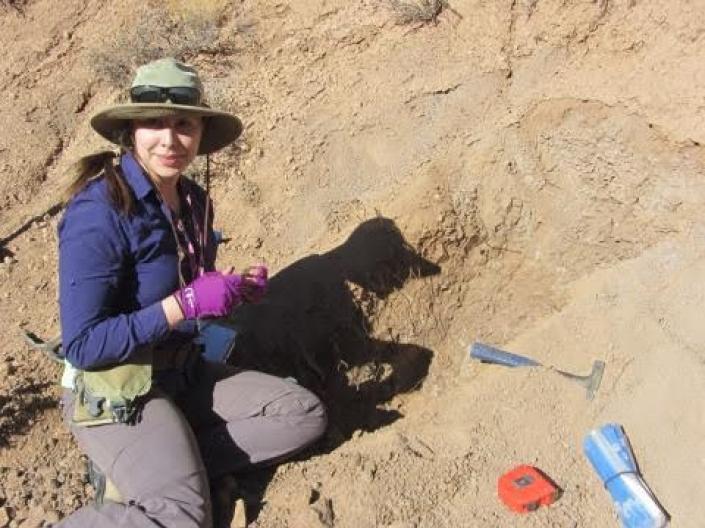
Our research focus is on
the evolutionary development of early hominids,
particularly the Plio-Pleistocene aged
Australopithecus fossils recovered from the
Middle Awash and Hadar regions of Ethiopia.
Field work in eastern Africa is combined with
laboratory analyses of the fossils to examine
the anatomical adaptations that occurred during
the transition from quadrupedality to bipedality.
Types of analyses include skeletal biomechanics,
the functional anatomy and evolution of the
hominid locomotor skeleton, and growth and
development of the musculoskeletal system.
Selected References:
Latimer, B., C.V. Ward. The
thoracic and lumbar vertebrae., in A. Walker and
R. Leakey, eds., The Nariokotome Homo Erectus
Skeleton. Harvard University Press,
Cambridge, pp. 266-293, 1993.
Jellema, L. M., B.
Latimer,., A. Walker, The rib cage., in A.
Walker and Richard Leakey, eds., The
Nariokotome Homo Erectus Skeleton. Harvard
University Press, Cambridge, pp. 294-325, 1993.
Ohman J.C., T.J. Krochta,
C.O. Lovejoy, R.P. Mensforth, and B. Latimer.
Cortical Bone Distribution in the Femoral Neck
of Hominoids: Implications for the Locomotion of
Australopithecus afarensis. Amer.
J. of Phys. Anthro. 104:117-131, 1997.
Lovejoy C., R. Meindle, R.
Tague, and B. Latimer. The comparative senescent
biology of the hominid pelvis and its
implications for the use of age-at-death
indicators in the human skeleton. In:
Integrating Archeological Demography:
Multidisciplinary approaches to prehistoric
populations. Ed. RR Paine, Southern Illinois
University at Carbondale, occasional paper No.
24, 43-63, 1997. |