
1997 Annual Security Report
Case Western Reserve University
Protective Services
Message from CWRU President
The CWRU Campus
CWRU Protective Services' Policies
Crime Prevention
Crime Statistics
Message from the President
Case Western Reserve University is committed to providing a safe campus environment. During the past decade, a variety of security and crime prevention initiatives have been implemented which have significantly reduced the level of criminal activity both on campus and in the University Circle area.
These programs include the establishment of a 24-hour security patrol force, security escort service, the installation of more than 150 emergency phones, enhanced parking lot security, and a variety of personal crime prevention programs. The University's Security Department was one of the first in the nation to implement a security alert program in order to increase security awareness. This program uses a phone/fax network to inform the University community of crimes or other incidents accurately and quickly.
This report is a continuation of the University's efforts to improve personal awareness regarding crime prevention. With your support we will continue to maintain a safe educational environment at Case Western Reserve University.
President Agnar Pytte
The CWRU Campus
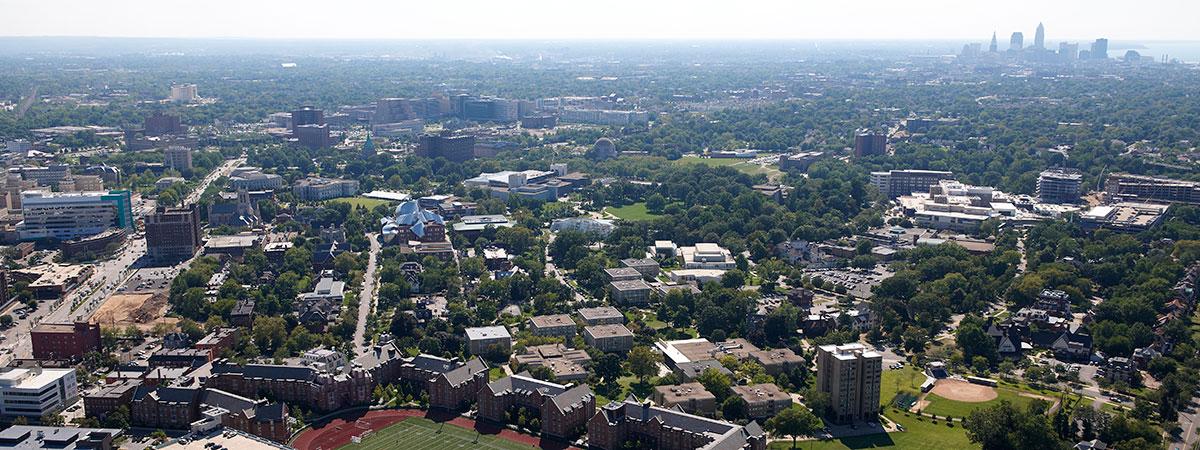
Case Western Reserve University is a 128-acre campus located in University Circle, the cultural and educational hub of the City of Cleveland. The University's unique location provides unparalleled access to a rich cultural setting, but does present the security and safety risks associated with any major metropolitan area and an urban environment.
The University provides a variety of security and safety programs to help ensure a safe educational environment. These programs are directed by the University Security Department with Administrative Offices located in the basement level of the Health Services Building, 2145 Adelbert Road, and the Patrol Operations facility located at the new North Campus Office at 1725 E. 115th St. just north of Euclid Avenue.
The sections below outline these programs and provide additional information related to campus security and safety.
Security and Police Patrols
CWRU Security
The University's Security Department is responsible for the administration of all security, crime prevention, and law enforcement programs on campus. The Security Department deploys a professional security force of 30 officers who patrol the campus on a 24-hour basis. Selected University Security personnel are commissioned as peace officers by the State of Ohio. Based on this commission, they have felony arrest authority. In addition to basic patrol, security personnel respond to all criminal incidents and alarms, and provide escorts and emergency assistance.
University Circle Police Department (UCPD)
In coordination with University Security, UCPD provides police and law enforcement services to the CWRU campus. UCPD deploys 24 commissioned peace officers. UCPD has full arrest authority, both on campus and within the boundary of University Circle (see map, page 4). UCPD works closely with the Cleveland and Cleveland Heights Police Departments, which also provide police services in their respective jurisdictions.
Escort Service
Through the deployment of a student security patrol supplemented by University security officers, a walking escort service is provided on a 24-hour-a-day basis. Escorts will accompany you to any location in the University Circle area. (Call x3333.) The department seeks to have an escort there within 10 minutes of receiving a call.
Night Shuttle Service
Through University Circle Inc., the University provides night shuttle service around campus each evening from 6 p.m. to 1 a.m. The night shuttle serves all primary campus locations including residence halls, libraries and gymnasiums. For a night shuttle schedule, contact security at x3333.
More than 150 campus emergency phones are strategically located throughout the campus. These phones may be used for both emergency and routine purposes. The phones are equipped with panic buttons which immediately identify the location of the call at Central Security Dispatch. In addition, there are 56 "code blue" police emergency phones located throughout University Circle.
Residence Hall Security
- There are 28 on-campus residence halls which house approximately 2,300 students. An additional 1,000 students live in University-owned apartments off campus and in off-campus fraternities. The University's residence halls are secured 24 hours per day, and access is restricted to residents and support staff. All guests must be accompanied by a resident.
- All of the residence halls are secured by a campus-wide card access system which requires the use of a valid University I.D. card. Any lost cards can be immediately invalidated to maintain security.
- Fire alarms are installed in all residence halls and are inspected in compliance with state fire codes. The Safety Services Office conducts fire drills each semester and provides information about fire safety on an ongoing basis.
- Crime prevention seminars are provided by University Security and police professionals in the residence halls as requested by the Student Housing Office.
Campus Facilities and Grounds
- Most University buildings are open to the public during normal business hours. All facilities are secured after normal hours. The University's facilities are maintained by the Plant Services Department. Plant Services incorporates security and safety considerations into its maintenance planning, including lighting, grounds keeping, and physical access.
- The University's Department of Occupational and Environmental Safety provides routine inspections of all campus facilities to identify safety hazards. The Plant Services Department promptly addresses any problems identified during these inspections.
CWRU Policies
- Drugs and Alcohol
CWRU will conform to all state and local laws controlling the sale and use of alcoholic beverages. It is illegal in Ohio to sell, provide, or serve beer, wine, or liquor to anyone under 21.
The unlawful manufacture, distribution, possession, or use of alcohol and controlled substances, including illicit drugs, is prohibited on property owned or operated by Case Western Reserve University or as part of any of its activities. CWRU will comply with all federal and state drug laws. No CWRU employee may report to or engage in University-related work while under the influence of alcohol or illegal drugs.
For information about the University's drug and alcohol abuse education programs, contact the Substance Abuse Prevention & Peer Education Coordinator at 368-3780. Employees may also call x6675 for information about the Employee Assistance Program.
- Weapons
Discharging, carrying, or possessing firearms, including air guns or any weapons with which injury, death, or destruction may be inflicted, is prohibited.
- Crime Reporting Procedures
All crimes which occur on campus should be reported to CWRU Security at x3333. Security will notify the appropriate police agency to respond, depending on the type of crime. Crimes occurring off-campus within the University Circle area should be reported to UCPD at 368-2222.
- Criminal Investigation and Prosecution
It is the policy of CWRU to inform all crime victims of their right to pursue criminal charges through the criminal justice system and provide assistance in this regard. In cases involving students, the Student Judicial Review Board will conduct hearings under due process guidelines. This process is available to victims, whether or not they pursue criminal charges. Additional information about the Judicial Review Board process may be found in the Student Services Guide, available from Student Affairs.
- Policy on Sexual Assault
Case Western Reserve University is a community dependent upon trust and respect for its constituent members: students, faculty and staff. Sexual assault is a violation of that trust and respect. It will not be tolerated. Sexual assault is a serious crime. Any non-consensual physical contact of a sexual nature is a sexual assault. Rape, statutory rape, incest, sodomy, sexual assault with an object, and fondling are examples of sexual assault. Lack of consent is the crucial factor in any sexual assault. Persons forced to engage in sexual contact by force, threat of force, or coercion have not consented to contact. Persons acting under the influence of alcohol or other substances may be incapable of consent. Age or mental capacity may render consent impossible.
The University strongly encourages persons who have been sexually assaulted to report the assault, to seek assistance and to pursue judicial action or sanctions for their own protection and that of the entire campus community.
- Reporting
To preserve the option of pursuing criminal sanctions or CWRU internal disciplinary processes, a person should report the sexual assault to the University and/or the local police. The University recognizes that a person who has been sexually assaulted retains the right not to pursue either criminal prosecution or a University judicial proceeding. However, the University strongly encourages those who have been sexually assaulted to pursue internal disciplinary and/or criminal processes. If a person who has been sexually assaulted chooses to pursue internal disciplinary procedures, he or she can expect a supportive response by the University throughout the disciplinary process. Reporting options are listed below. In addition, graduate and professional students can report an incident of sexual assault to their respective student affairs office.
Once a report of sexual assault is made, the University may be obligated to alert the campus community of the report. The University is obligated to alert the campus of crimes that it determines represent a threat to members of the campus community. In making such determinations, the University will consider the safety of students, faculty and staff, as well as the privacy interests of all persons involved in such incidents. Regardless of the action taken by the University, the names of any person involved will not appear on security alerts. The University urges anyone who has been sexually assaulted to report the incident at any time. However, prompt reporting may preserve options that delayed reporting does not, including the preservation of physical evidence, crisis counseling, and immediate police response.
- Medical and Psychological Assistance
- Emergency Room Examination: Any person who has been sexually assaulted may go directly to the University Hospital Emergency Room or any local hospital for medical attention. Please note: The preservation of physical evidence is critical in the event of criminal prosecution and may be useful if University disciplinary action is pursued.
- University Health Services: Students can seek further treatment at the University Health Services for any medical concerns, including sexually transmitted diseases and pregnancy testing.
- Counseling: Counseling may be pursued following a sexual assault, no matter how much time has elapsed since the incident. Counseling services are confidential except when disclosure is necessary to prevent imminent harm to self or others. Available options, on and off-campus are listed below. To inquire about other community counseling resources, please call 368-5872. All inquiries are confidential.
| University Counseling Services
|
| 368-5872 |
Weekdays |
|
|
| 844-8892 |
After 5 pm, weekends, holidays |
| Cleveland Rape Crisis Center
|
| 391-3912 |
24 Hours |
| Witness-Victim Center
|
| 443-7345 |
|
- University Sanctions/Criminal Prosecution
Anyone who has been sexually assaulted may choose to pursue both criminal prosecution and University disciplinary processes. Regardless of whether criminal charges are filed, all members of the University community accused of sexual assault may be subject to University judicial action or sanctions, up to and including expulsion or termination from employment. In the case of student judicial proceedings, both the accused and the accuser are entitled to due process, to the presence of an advocate during hearings and to notification of the outcome of the proceedings.
- Accommodations
In the aftermath of a sexual assault, the University will accommodate requests for alternative living, working and academic arrangements as available and appropriate.
Due to the sensitive and traumatic nature of sexual assault, specially trained members of the University are available to help anyone who has been sexually assaulted understand the many options open to him or her. To contact a member of the Sexual Assault Response Team, call:
| 368-5872 |
Monday through Friday, 8:30 a.m.-5 p.m. |
| 844-8892 |
After 5 p.m., Weekends & Holidays |
Please tell the operator that this is an emergency or that a sexual assault has occurred. Conversations with members of the response team are confidential, except when disclosure is necessary to prevent imminent harm to self or others.
When medical attention or police assistance are critical, call 368-3333 for CWRU Security, 368-2222 for University Circle Police, or 911 for local police.
Crime Prevention
Visit the CWRU Security Crime Prevention Page
Operation Awareness
Through "Operation Awareness," the University's award-winning Crime Prevention Program, a variety of crime awareness and personal safety programs are provided. These include the following:
- Monthly crime awareness newsletters, which summarize criminal activity, are distributed throughout the campus.
- Emergency Security Alerts are faxed to all campus departments and residence halls whenever a serious incident is reported. Copies are posted in the Campus News area on Free-Net (type go cwru.news, and select "Security Alerts" from the gopher menu.)
- A variety of vehicle and property protection services are provided.
- Vehicle identification numbers can be etched on car windows as a theft deterrent. There is a $10 fee per vehicle for VIN etching.
- U-shaped Kryptonite bicycle locks can be rented for $3 per year, with a deposit of $15 or $20, depending on the lock size.
- NEW PROGRAM: Have your bike registered free of charge. A weatherproof decal will be attached to your bike for easy identification.
- Bolt-down devices are available to secure computers, peripherals, or other major office equipment. Costs vary, based on the type of device needed to secure the equipment.
- Security makes free loans of electric engravers to etch identifying numbers or names on property.
- Security and crime awareness orientation programs are conducted for new students. Departments and student groups can request presentations on safety and security.
To obtain more information on these programs, contact Sergeant Karen Gregor at the Crime Prevention Office, now located just north of Euclid Avenue at 1725 East 115th St. in our North Campus Security Office. Karen is available Monday through Friday from 8 a.m. to 4 p.m. at 368-6811. If you are unable to reach her, call George Michalke at 368-2908 at the same location.
Most of the crimes that occur on campus, or anywhere else for that matter, are crimes of opportunity and they are very easy to stop. Remove the opportunity and you stop the crime. Secure easy-to-carry items in a locked desk or cabinet, a thief knows where purses are usually kept, like on the floor behind a desk or in the lower right hand desk drawer. A wallet left in the pocket of a jacket or coat hanging behind the door or on a chair are also well known locations for a thief.
Preventing crime is everyone's concern, from protecting yourself and your property to looking out for others and the university. Be aware of what is happening around you, who has come into your area and what they are doing. A friendly, "May I help you" is often enough to discourage a thief, as he may realize that someone has taken note of him and not want to be associated with a crime at that time.
The more you know about a subject the easier it becomes. Know how to protect yourself and your property by learning more about crime prevention, it's much easier than learning it the hard way-by becoming a victim. Crime Prevention is not STOPPING something NEGATIVE from happening, it's STARTING something POSITIVE.
Crime Statistics
The University maintains permanent records of all crimes reported on campus and those occurring off campus involving CWRU faculty, staff, and students. Through the UCPD, all campus crimes are entered into the Cuyahoga Regional Information System and related public data bases.
Number of Reports
| Crime* |
1996 |
1995 |
1994 |
1996 |
1995 |
1994 |
| Homicide |
0 |
0 |
0 |
0 |
0 |
0 |
| Robbery |
4 |
5 |
4 |
1 |
0 |
0 |
| Burglary |
9 |
2 |
9 |
3 |
4 |
2 |
| Aggravated Assault |
1 |
2 |
0 |
0 |
1 |
0 |
| Motor Vehicle Theft |
12 |
14 |
13 |
8 |
4 |
1 |
| Sex Offenses |
|
|
|
|
|
|
| Forcible |
|
|
|
|
|
|
| Rape |
0 |
0 |
1 |
0 |
1 |
0 |
| Other |
0 |
0 |
0 |
0 |
0 |
0 |
| Non-Forcible |
0 |
0 |
0 |
0 |
0 |
0 |
| Liquor Law Violations |
0 |
0 |
0 |
0 |
0 |
0 |
| Drug Abuse Violations |
0 |
0 |
0 |
0 |
0 |
0 |
| Weapons Possession |
0 |
0 |
0 |
0 |
0 |
0 |
* None of the reported crimes or arrests can be characterized as hate crimes. Hate crimes are defined as crimes that manifest evidence of prejudice based on race, religion, sexual orientation or ethnicity.
** Limited to crimes at University-owned properties and/or recognized student organizations.
|