
2018-2019
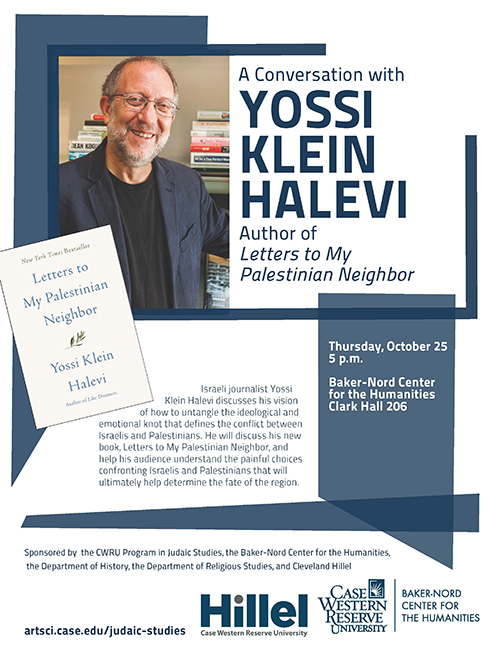
A Conversation with Yossi Klein Halevi, Author of “Letters to My Palestinian Neighbor”
Thursday, October 25, 2019
5:00pm – 7:00pm
Baker-Nord Center, Clark Hall 206
Empathizing with Palestinian suffering and unraveling the complex strands of faith, pride, anger and anguish he feels as a Jew living in Israel, journalist Yossi Klein Halevi discusses his vision of how to untangle the ideological and emotional knot that defines the conflict between Israelis and Palestinians. He will discuss his new book, Letters to My Palestinian Neighbor, and help his audience understand the painful choices confronting Israelis and Palestinians that will ultimately help determine the fate of the region.
Sponsored by The Program in Judaic Studies; Cosponsors, Baker-Nord Center for the Humanities, Department of History, Department of Religious Studies, Cleveland Hillel
2009-2010
2009 Silver Scholar Lecture

Vanessa Ochs
Thursday, October 29, 2009
4:30 p.m., Clark Hall, Room 309 (Refreshments starting at 4:00 p.m.)
11130 Bellflower Road, Cleveland
Vanessa Ochs is the author of numerous books and articles including Inventing Jewish Ritual, Sara Laughed,The Book of Jewish Sacred Practices (co=edited with Irwin Kula). Her research interests include the anthropology of Judaism, women in Judaism, material culture and the study of religions, new ritual, healing in Jewish tradition, and literature of spiritual journeys. She is associate professor of Religous Studies at the University of Virginia.
The Silver Scholar Lecture is cosponsored by the Samuel Rosenthal Center for Judaic Studies at Case Western Reserve University and The Temple Tifereth Israel.
2008-2009

Stephen Hazan Arnoff
“About Man and God and Law”: Bob Dylan and Religion
Wednesday, March 25, 2009; 4:30 p.m.
Clark Hall, Room 309, 11130 Bellflower Road, Cleveland
As rock and roll’s greatest poet and one of the most important artists in any medium over the past half century, Bob Dylan wrestles with religion at the heart of his work. From iconoclast to Zionist to fundamentalist and back, explore Dylan’s encounter with God, the Bible, Israel, religious identity, faith, and morality. In a discussion illustrated by selected clips of music, video, and text, scholar of popular and Jewish culture Stephen Hazan Arnoff explains how Dylan’s pursuit spiritual truth embodies a modern quest of many great artists and intellectuals to make sense of ancient traditions and folkways when religious institutions and practice fail them. A self-defined religious outlaw, learn how Dylan makes sense of his own creed: “To live outside the Law you must be honest.”
Stephen Hazan Arnoff, born and raised in Cleveland, is Executive Director at the 14th Street Y in New York City. Called the “The Godfather of the Jewish cultural revolution” by writer Jay Michaelson, Arnoff’s work includes “The Tale of a Boy Who Would be King”, a rock opera with school curriculum informed by the Book of Jonah. He was founding director of Artists Networks and Programming at the Makor/Steinhardt Center of the 92nd Street Y, and served as managing editor of Zeek: A Jewish Journal of Thought and Culture. The author of numerous works on art, culture, and education and his writings have been published in Hebrew, Italian, and English. He received a B.A. degree from Brandeis University and an M.A. in Midrash from the Jewish Theological Seminary of America.
Arnoff–article on Bob Dylan
Zeek: A Jewish Journal of Thought and Culture
Zev Garber
Imagining the Jewish Jesus
Sunday, May 24, 2009
Part of the symposium, Jesus in the Context of Judaism and the Challenge to the Church.
In a recent review essay on the scriptural Jesus (“Reflections on Jesus,” Shofar 27. 2, 2009), Garber postulates that the Easter faith without its Jewish historical context is unwieldy, or worse, a proven feeding ground for centuries old Good Friday sermons that espoused anti-Judaism (replacement theology, conversion of the Jews) and anti-Semitism (“perfidious Jews and Christ killers”). A critical read of the “Golden Rule,” the Last Supper, and the Great Commandment in the context of Jewish exegesis will show how and why.
Zev Garber is professor and chair of Jewish Studies at Los Angeles Valley College and has served as Rosenthal Visiting Fellow at Case Western Reserve University, visiting professor in Religious Studies at the University of California at Riverside and president of the National Association of Professors of Hebrew (NAPH). Currently he is editor of Iggeret (newsletter of NAPH), editor-in-chief of Studies in Shoah series (UPA), co-editor of Shofar, founding editor of Shofar Supplements in Jewish Studies, and editorial advisor to Western States Jewish History. Author of many academic articles and reviews, his book publications include Post-Shoah Dialogues: Rethinking Our Texts Together (with Steven Jacobs, Henry Knight, and James Moore, ed., 2004) and Mel Gibson’s Passion: The Film, the Controversy, and Its Implications (2006). In 2009, the impact of Garber’s scholarly contributions to the field were acknowledged with the publication of Maven in Blue Jeans: A Festschrift in Honor of Zev Garber (Purdue University Press).
Richard L. Rubenstein
Jesus, Paul, and Christology
Monday, Mary 25, 2009
Part of the symposium, Jesus in the Context of Judaism and the Challenge to the Church
In much of thoughtful Jewish New Testament scholarship, there has been a long tendency to regard Paul of Tarsus as the ultimate apostate. Richard L. Rubenstein, author of My Brother Paul, sees a profound fraternal relation between the disciples of Paul and rabbinic Israel. Rubenstein will explore this and other such issues as the Church and Synagogue, the connection between Judaism and Christianity, and sacrifice in Christianity and Judaism. He will explore the complex interrelations of the two faiths and the conflicts between them.
Richard L. Rubenstein is President Emeritus and Distinguished Professor of Religion at the University of Bridgeport. He also serves as Director of the University’s Center for Holocaust and Genocide Studies. An internationally recognized historian of religion whose writings lie at the root of Holocaust writings, his works have been the subject of more than a dozen doctoral dissertations. Professor Rubenstein’s writings also have been cited as a key inspiration for the Academy Award winning film Sophie’s Choice. Prior to assuming his role as President of the University of Bridgeport, Dr. Rubenstein served as Distinguished Professor of Religion at Florida State University, where a Chair for Religious Studies was established in his honor.
2007-2008
2007 Silver Scholar Lecture

Robert Pinsky
The Popularity of Poetry in the United States
Former U.S. Poet Laureat Robert Pinsky discusses The Favorite Poem Project
Thursday, October 11, 2007
4:30 p.m., Thwing Ballroom (Refreshments starting at 4:00 p.m.)
11111 Euclid Avenue, Cleveland
Book signing immediately following the lecture
Photo by Emma Dodge Hanson
The Silver Scholar Lecture is cosponsored by the Samuel Rosenthal Center for Judaic Studies at Case Western Reserve University and The Temple Tifereth Israel.
Robert Pinsky’s first two terms as United States Poet Laureate were marked by such visible dynamism, and such national enthusiasm in response, that the Library of Congress appointed him to an unprecedented third term. Throughout his career, Pinsky has been dedicated to identifying and invigorating poetry’s place in the world.
As Poet Laureate, Robert Pinsky became a public ambassador for poetry, founding the Favorite Poem Project, in which thousands of Americans – of varying backgrounds, all ages, and from every state – shared their favorite poems. Pinsky believed that, contrary to stereotype, poetry had a vigorous presence in the American cultural landscape. The project sought to document that presence, giving voice to the American audience for poetry.
A prolific author and PBS essayist, Pinsky’s works include Gulf Music, The Figured Wheel: New and Collected oems 1966-1996 (a Pulitzer Prize nominee and Lenore Marshall Award winner), Poetry and the World (National Book Critics’ Circle Award nominee), the best-selling translation of The Inferno of Dante (received Los Angeles Times Book Award in Poetry), and The Life of David, a lively volume of prose retelling and examining the David stories and scripture.
Listen to Mr. Pinsky read his poem, “Shirt”
More Information on Mr. Pinsky (Academy of American Poets website)

Sari Nusseibeh
“Once Upon a Country–A Palestinian Life”
Sunday, October 14, 2007; 3:30 p.m.
Cleveland Hillel Foundation, 11291 Euclid Avenue, Cleveland
Sponsored by the Samuel Rosenthal Center for Judaic Studies and the Center for Policy Studies at CWRU, the Cleveland Hillel Foundation, Tikkun/Cleveland., and The Church of the Covenant.
Free parking for Dr. Nusseibeh’s lecture and the Building Bridges Mural Dedication is available at the Church of the Covenant lot (entrance on Euclid) and Ford Road Garage (entrance on Ford), courtesy of The Church of the Covenant.
Sari Nusseibeh is a Palestinian professor of philosophy and president of the Al-Quds University in Jerusalem. Dr. Nusseibeh will discuss his book, Once Upon a Country-A Palestinian Life, which he co-authored with Anthony David. Dr. Nusseibeh was the Palestine Liberation Organization’s chief representative in Jerusalem from 2001 to 2002, in which role he advocated a two-state solution to the Israel-Palestine conflict. Dr. Nusseibeh and Ami Ayalon are the co-founders of The People’s Voice, an Israeli-Palestinian civil initiative that aims to advance the process of achieving peace between Israel and the Palestinians.
Dr. Nusseibeh received his bachelor’s and master’s degrees in politics, philosophy, and economics from Oxford University and his doctoral degree in Islamic philosophy from Harvard University. From 1978 through 1990, he taught philosophy and cultural studies at Birzeit University in the West Bank. He has lectured widely in Europe and the United States and has received many prizes and awards for his work.
Photo: Rina Castelnuovo
Also of Interest:
Mural Dedication: Building Bridges Mural Program
Sunday, October 14, 2007; 5:00 p.m.
The Church of the Covenant
11205 Euclid Avenue, Cleveland
(The Church of the Covenant is immediately adjacent to The Hillel Foundation)
The public is cordially invited to a dedication ceremony for the Building Bridges Mural Program, sponsored by the members of the Inter-Religious Council of Case Western Reserve University. “The Interfaith Mural” by artist Katherine Chilcote will be dedicated at 5:00 p.m., followed by a reception.
Navras Jaat Aafreedi
Jewish Contributions to Indian Cinema
Monday, November 19, 2007; 4:30 p.m.
Clark Hall, Room 309, 11130 Bellflower Road, Cleveland
Free and open to the public
Visitor Parking: Metered lot, corner of Euclid and Ford
Severance Hall garage, entrance on East Boulevard
Navras Aafreedi will discuss the contributions of the native Jewish community, with a particular emphasis on the role of Jewish women, in the early days of the Indian film industry. Today the Indian film industry is the largest in the world producing approximately 800 films annually. In the industry’s infancy, pioneering Jewish women played a crucial role in silent films. These women braved the sigma of acting on stage-a practice prohibited by society at the time for Muslim women. Gradually educated women from other communities entered the acting profession. When sound films were introduced many illustrious Jewish actors lost their careers because they were not fluent in Indian languages.
Navras Aafreedi received a Ph.D. from the University of Lucknow in India in 2005, and was a post doctoral fellow at the Graduate School of Historical Studies at Tel Aviv University. A book based on his doctoral dissertation on “The Indian Jewry and the Self-Professed ‘Lost Tribes of Israel’ in India” has been published in electronic form. Aafreedi is one of the few researchers making scholarly contributions in Jewish Studies in the Urdu language, the most popular language among all South Asian Muslims.
Abraham Diskin
Israeli Politics and Palestinian Politics:
Internal Pressures and the Prospects for Peace
Tuesday, April 8, 2008
7:30-9:00 p.m.
Ford Auditorium, Allen Medical Library
A conversation with Abraham Diskin, Ph.D., Associate Professor of Political Science at Hebrew University and Rex Brynen, Ph.D., Professor of Political Science at McGill University
(co-sponsored with the Case Center for Public Policy)
2006-2007
Bruce Feiler
Sunday, September 10, 2006, 8 p.m.
Matlz Museum of Jewish Heritage
2929 Richmond Road, Beachwood, OH
Telephone: 216/593-0575
Tickets $22.50 for Maltz Museum Members/$25.00 for non-members
In partnership with the Samuel Rosenthal Center of Case Western Reserve University, Cleveland State University, John Carroll University, Notre Dame College, with the sponsorship of Laura and Alvin Seigal College and Ursuline College.
Special appearance in conjunction with the “Cradle of Christianity: Treasure from the Holy Land” exhibition at the Maltz Museum. Feiler is the author of “Walking the Bible: A Journey by Land Through the Five Books of Moses and Abraham”, and other besting sellers.
Susannah Heschel
The Merchant of Venice: Shylock in Christian and Jewish Imaginations
October 3, 2006, 4:30-6 pm
Hartzmark Room
The Temple-Tifereth Israel
26000 Shaker Boulevard
Beachwood, OH
(note location change)
The problem of the Jewish presence within Europe has long been addressed in a variety of texts, but The Merchant of Venice is a key text in transmitting and reflecting attitudes toward Jews among European Christians. Not only classical Christian theology, but political issues of nationalism, race, and gender are expressed in the play through its interrogations of body and soul, money and blood, fathers, daughters, and patrimony, marriage and conversion, religious difference and transgendering. Readings of the play have differed widely over the centuries, and variations in modern productions of the play in several different cultural contexts are clues to Jewish and Christian self-understanding. Most striking in those variations are three settings in which Jewishness has been of central concern: the modern German stage, the Yiddish theatre in New York, and the State of Israel. The German stage produced the most antisemitic Shylock, while the Yiddish and Hebrew performances reflect significant developments in the repudiation of antisemitism and affirmation of Jewish identity.
Susannah Heshcel was founding director of the Samuel Rosenthal Center at Case Western Reserve University. She holds the Eli Black Chair in Jewish Studies in the Department of Religion at Dartmouth College. She received her PhD in Religious Studies at the University of Pennsylvania in 1989, and was awarded an honorary Doctor of Humane Letters from Colorado College in 2005. Prior to Dartmouth, she taught at Southern Methodist University and held the Abba Hillel Silver chair in Jewish Studies at Case Western Reserve University.
Henry F. Knight, Jr.
Canopies of Hospitality in and for a Wounded World:
Midrashic Imagination and Post-Shoah Faithfulness
Wednesday, November 8, 2006; 4:30 p.m., Clark Hall 206; 11130 Bellflower Road
For people committed to the conventional faith traditions of Judaism, Christianity, and Islam, the Holocaust represents a fundamental challenge to the convenantal character of creation and the role of any people who understand themselves to be stewards of creation’s convenantal ways and representatives of God’s intentions for human responsibility and faithfulness. Drawing on the resources of midrash, Dr. Knight will explore how an event like the Shoah challenges people of faith to reground themselves in their understandings of their traditions in a theology of creation capable of embracing the other as other without losing one’s own identity in the process.
Henry F. Knight, a Christian minister, is Director of the Council for Holocaust Education in Tulsa, Oklahoma, a joint venture of educational outreach to the wider Tulsa community of the Jewish Federation of Tulsa and the Sherwin Miller Museum of Jewish Art. He was formerly on the faculty of The Univeristy of Tulsa where for twelve years he served as University Chaplain and Associate Professor of Religion before assuming his most recent poistion there as Applied Associate Professor of Hermeneutic and Holocaust Studies. Dr. Knight also served as Chaplain and Associate Professor of Religion at Baldwin-Wallace College in Berea, Ohio from 1979 to 1991. Knight is the author of Celebrating Holy Week in a Post-Holocaust World (2005), Confessing Christ in a Post-Holocaust World (Greenwood Press, 2000; reissued in paperback by Wipf and Stock, 2006), and co-editor with Marci Sachs Littell of The Uses and Abuses of Knowledge (1997).
Rosenthal Visiting Fellow
David Silberklang, Ph.D.
What Don’t We Know? Unanswered Questions from the Holocaust 
Wednesday, February 7, 2007
4:00 p.m. reception; 4:30 p.m. Presentation
1914 Lounge, Thwing Center, 11111 Euclid Avenue, Cleveland
Much has been researched, analyzed, and written
about the Holocaust in the last 60-plus years. The Holocaust is, arguably, the most extensively researched event in history. Yad Vashem’s library alone contains some 110,000 book titles and many thousands more articles relating to the subject. Indeed, many may wonder if there is any major aspect of the Holocaust that remains to be studied. Based on the extant voluminous scholarship on the Holocaust, this talk argues that there are many outstanding fundamental issues to be researched and explained, enough to keep the scholars and thinkers busy for many years to come. We have barely scratched the surface.
David Silberklang is the Rosenthal Visiting Fellow for Spring 2007 for Case Western Reserve University’s Judaic Studies Program. David Silberklang is a senior historian at Yad Vashem, where he serves as Editor-in-Chief of Yad Vashem Studies, a leading scholarly journal on the Holocaust. He is also a lecturer in Jewish History in the Rothberg International School at the Hebrew University of Jerusalem, and has taught graduate seminars in the Institute for Contemporary Jewry at Hebrew University as well. At Yad Vashem, he is also Series Editor of the survivor memoir series – the Holocaust Survivors’ Memoirs Project. In April 2006 he was appointed Israel’s representative on the Academic Working Group of the Task Force for International Cooperation on Holocaust Education, Remembrance and Research.
Rosenthal Visiting Fellow
David Silberklang
Hanging by a Thread: Reflections on Being a Jew in the Holocaust
March 11, 2007, Cleveland Downtown Marriott (Salon D-E, 2nd floor)
5:30 p.m. to 7:00 p.m.
Reception and Dinner: $55.00 (MasterCard/Visa accepted); prepaid reservations required; $55.00 per person (includes reception and dinner).
Valet Parking available.
Dr. Silberklang’s presentation is part of the 37th Annual Scholars’ Conference on the Holocaust and the Churches, being held March 11-13, 2007 at the Cleveland Downtown Marriott. Immediately after Dr. Silberklangs lecture, please join him for a free public paper session on “New Approaches in Teaching the Holocaust” at the Cleveland Marriott (Salon B-C, 2nd floor)
David Silberklang is the Rosenthal Visiting Fellow for Spring 2007 for Case Western Reserve University’s Judaic Studies Program. David Silberklang is a senior historian at Yad Vashem, where he serves as Editor-in-Chief of Yad Vashem Studies, a leading scholarly journal on the Holocaust. He is also a lecturer in Jewish History in the Rothberg International School at the Hebrew University of Jerusalem, and has taught graduate seminars in the Institute for Contemporary Jewry at Hebrew University as well. At Yad Vashem, he is also Series Editor of the survivor memoir series – the Holocaust Survivors’ Memoirs Project. In April 2006 he was appointed Israel’s representative on the Academic Working Group of the Task Force for International Cooperation on Holocaust Education, Remembrance and Research.
Interview with David Silberklang

Abraham J. Peck
Germans and Jews after the Holocaust: From Family History to Tikkun Olam
March 13, 2007
4:30 p.m. (refreshments starting at 4:00 p.m.)
Clark Hall, Room 309; 11130 Bellflower Road, Cleveland
For more than 15 years, Abraham Peck, the son of survivors, and Gottfried Wagner, the son of Nazi supporters, began an open and honest dialogue in order to understand how their lives and family histories were shaped from their Holocaust experiences. Through the years, the dialogue, which was difficult at times, was expanded to include the children and grandchildren of other Holocaust victims and perpetrators in the hope of starting a world-wide dialogue against genocide and religious, policial, and social injustices
Peck is a pioneer in research the history of Holocaust survivors and Jewish Displaced Persons after 1945. His moher and father were the only members of two large Polish-Jewish families to survive the Holocaust. Peck is the co-author, with Gottfried Wagner, of “Our Zero Hour: German and Jews after 1945–Family History, Holocaust and New Beginnings Historial Memoirs (2006). Gottfried Wagner is the great grandson of composer Richard Wagner, a member of one of German’s most influential families that was depply involved in Hitler’s work and vision.
Video of Dr. Peck’s lecture
2005-2006
Rosenthal Visiting Fellow
Gideon Shimoni
Rights to the Land of Israel: Claims and Compromises
Wednesday, September 28, 2005
4:30 p.m., Clark Hall, Room 309, 11130 Bellflower Road, Cleveland
In his lecture, Professor Shimoni will discuss from an historical perspective the nature of Jewish claims to national self-determination in the Land of Israel/Palestine as expressed over time and across the spectrum of Zionist ideologies. He will examine the various Zionist responses to Palestinian Arab counterclaims, and analyze the record of compromise options up to the present. His presentation is especially timely in view of the current withdrawal of the Jewish settlers from Gaza.Professor Gideon Shimoni is head of the Institute of Contemporary Jewry, and Shlomo Argov Chair in Israel-Diaspora Relations at The Hebrew University of Jerusalem. He has published extensively in the field of twentieth century Jewish history, with a particular focus on the history of Zionism and the Arab-Israeli conflict.
His books include Jews and Zionism: The South African Experience 1910-1967 (1980), Gandhi, Satyagraha and the Jews: A Formative Factor in India’s Policy towards Israel (1977), The Zionist Organization: Changes in Ideology and Status (1990), Zionist Thought Today: A Selection of Readings (1993), and a seminal volume entitled, The Zionism Ideology (1995), which won the Arnold Wiznitzer Prize of the Institute of Jewish Studies at The Hebrew University. His latest work includes, Community and Conscience: The Jews in Apartheid South Africa (2003). Originally from South Africa, Professor Shimoni received his bachelor’s degree from the University of Witwatersrand, and Master’s and Ph.D. degrees from The Hebrew University. He has taught at Hebrew Union College (Los Angeles), the University of Washington, Seattle, and the Jewish Theological Seminary.
2005 Silver Scholar Lecture
Sherwin B. Nuland, M.D.
The Artist Studies the Doctor: A Millennium of Observation
Thursday, October 27, 2005 – 4:30 p.m.
Ford Auditorium in the Allen Memorial Medical Library, 11000 Euclid Avenue, Cleveland
In his lecture, The Artist Studies the Doctor: A Millennium of Observation, Dr. Sherwin B. Nuland will discuss the ways in which artists, down through the centuries, have described and commented on the state of medicine of their time. Through paintings, caricatures, illuminated
manuscripts and other forms of illustration, artists have sometimes praised and sometimes poked fun at the medical profession, its
contributions, its values, and its ethics.
Dr. Nuland is a clinical professor of surgery at Yale and has taught courses in bioethics and medical history. He has authored several medical books and has written nine books
of non-fiction including Lost in America: A Journey with my Father. In 1994 he won the National Book Award for How We Die: Reflections on Life’s Final Chapter.
Ori Z. Soltes
Purim and Passover: History, Myth, Theology and Art
in the Jewish Spring Festivals
Thursday, March 30, 2006
4:00pm, Mather Memorial, Room 201, 11120 Bellflower Road, Cleveland
(located on the corner of Ford and Bellflower, across from the Peter B. Lewis Building).
Sponsored by the Judaic Studies program.
Ori Z. Soltes will compare and contrast the two key Spring holidays in Jewish tradition. He will address history, myth, theology and art in the narrative context of both festivals, the importance of each in shaping Judaism and Jewish identity, and the reflection of these issues in the rich visual traditions of the Haggadah and the Megillat Esther.
Ori Z. Soltes is Goldman Professorial Lecturer in Theology and Fine Arts at Georgetown University, as well as a frequent lecturer in the National and Resident Associate Programs of the Smithsonian Institution. He is also the Executive Director of the Committee for the Republic, whose mission is to generate public discourse regarding the dangers imposed on the American Republic by the current Imperial face it presents to the world. Professor Soltes is the former Director and Curator of the B’nai B’rith Klutznick National Jewish Museum in Washington, DC, where he curated over 80 exhibitions. He has taught and lectured in 23 other universities and museums throughout the country, on subjects ranging from the Arab-Israeli conflict to The Body in Ancient Art. As Director of the National Jewish Museum, he co-founded the Holocaust Art Restitution Project, of which he currently continues as chairman. Both before and since his years as a museum Director, he has guest-curated exhibitions across the United States and overseas.
Professor Soltes was educated in Classics and Philosophy at Haverford College, in Classics at Princeton University and The Johns Hopkins University and in Interdisciplinary Studies at Union University. He is the author of over 130 articles, exhibition catalogues, essays and books on a wide range of topics, and the writer, director and narrator of seven documentary videos, including a 26-part, 13-hour-long work on the definition of Jewish art, called Tradition and Transformation. His most recent books are Fixing the World: Jewish American Painters in the Twentieth Century (University Press of New England Press, 2002) and Our Sacred Signs: Art in the Christian, Jewish and Muslim Traditions, (Westview Press, 2005). Three current book projects include The Ashen Rainbow: Essays on the Arts and the Holocaust, (Bartleby Press, forthcoming, 2006); Untangling the Tangled Web: A Brief Guide to the Problematic of the Middle East (forthcoming, 2006); and Beyond Heaven and Earth: Mysticism in the Jewish, Christian and Muslim Traditions (forthcoming, 2006).
2004-2005
Amos Guiora
International Law and Morality in Armed Conflict
Amos Guiora, Visiting Professor, School of Law
Thursday, October 28, 2004
4:30 p.m., Clark Hall, Room 309
Public Performance:
“It Sounds Better in Amharic”
Nephesh Theatre Group: A performance starring Yossi Vassa
Thursday, December 2, 2004 – 7:00 p.m. Strosacker Auditorium
Written by Yossi Vassa and Shai Ben Attar
Directed by Shai Ben AttarTranslated by Howard Rypp
Music by Tomer Yosef
Set Design by Adi Katz
Strosacker Auditorium
Free and Open to the Public
(Recommended for audiences 16 years of age and older.)
Sponsored by The Cleveland Hillel Foundation, and the Program in Judaic Studies, the Rosenthal Center for Judaic Studies, and the Ethnics Studies Program in the College of Arts and Science at Case Western Reserve University.
“It Sounds Better in Amharic” is an autobiographical account of the Vassa’s family arduous 435 mile foot journey from Ethiopia to a refugee camp in Sudan followed by the family’s emigration to the Holy Land when Vassa was age 10. In this poignant one-man show, nostalgic memories of life in Ethiopia are mixed with hilarious perspectives towards the adjustments that must be made when moving to modern day Israel.
Yossi Vassa began his career as a teenager and put himself through college by selling videotapes of comic routines he had written. He later appeared regularly on the weekly Israeli comedy television show, “Am Yisrael Live” – a show in the tradition of Saturday Night Live.
Rosenthal Visiting Fellow, Spring 2005
Zev Garber
Rethinking the Problem of Edith Stein: Jew and Catholic Saint
Wednesday, January 26, 2005 – 4:30 p.m., Clark Hall, Room 206
Professor Garber focuses on the controversy surrounding the religious identity of Edith Stein, a Jewish woman who became a nun, and the intent of the Catholic Church in sanctifying her as a martyr, and the Jewish fear of Christianizing the Shoah (Holocaust). Perspectives using Rabbinical law (Halakhah), Vatican directive, and Israeli Supreme Court ruling will be presented.
Meet the Playwright–Omri Yavin
Thursday, February 17, 2005 – 4:30 – 6:30 p.m. , Public Reception
Clark Hall, Room 206
Omri Yavin, a visiting playwright from Israel, currently is Lecturer of Hebrew in the Department of Modern Languages and Literatures at Case. His new play, Here Comes Dad, will be presented February 11 – 20, 2005 as part of the Eldred Theatre Drama Series at Case. The play is inspired by the Biblical story of the Sacrifice of Isaac and explores the relationship between a father and son. The Rosenthal Center welcomes the public to this reception in which you may meet the playwright Omri Yavin.
Rosenthal Visiting Fellow
Zev Garber
Mel Gibson’s ‘The Passion of the Christ’ – One Year Later
Roundtable Discussion
Sunday, April 10, 2005, 3:30 p.m.
Clark Hall, Room 309; 11130 Bellflower Road
Mel Gibson’s film, The Passion of the Christ, was released one-year ago to capacity audiences in theatres and auditorium across the U.S. and other countries. Prior to the film’s release, a groundswell of controversy filled the airwaves and media outlets. Some religious groups protested the film, while others embraced it. Now releasing a re-cut version of the film which eliminates about six minutes of the most graphic and violent portions, Gibson states, “I hope to make my film and its message of love available to a wider audience”. But what is the real impact of this film by one of the world’s most recognized icons? Professor Zev Garber and six invited scholars will lead a roundtable discussion, which is expected to last from 3:30 to 5:30 p.m.
Public Performance:
Claudia Stevens
“An Evening with Madame F”
Sunday, April 10, 2005 – 7:00 p.m., Thwing Ballroom
Claudia Stevens will explore the life and death experience of music performance in concentration camps, drawing on survivor accounts including those of Fania Fenelon, who performed in the women’s orchestra at Auschwitz. The performance will include actual music played in Auschwitz as well as first-hand accounts. Ms. Stevens is the daughter of Holocaust survivors.
2003-2004
Judith Neulander
Crypto-Jews of the Southwest: Truth or Illusion
September 24, 2003, 4:30 p.m., Clark Hall, Room 206
Judith Neuland is an Instructor in the Department of Religious Studies at Case Western Reserve. She has a Ph.D. from the Institute of Folklore and Ethnomusicology at Indiana University, Bloomington, and Masters degrees in Jewish Studies and World Arts and Cultures from UCLA. Her dissertation research on an alleged crypto-Jewish survival in the American southwest was written up in “The Atlantic Monthly,” and her scholarly publication on this topic received first prize for publication on folklore and religion from the American Folklore Society.
Rosenthal Visiting Fellow
Isaac Kalimi
The Book of Esther in Judaism and Jewish Theology
October 29, 2003, 4:30 p.m., Clark Hall, Room 206
Dr. Kalimi is this year’s Rosenthal Visiting Professor in the Department of Classics at Case Western Reserve University. His area of academic specialty is the ancient history of the Jewish people, Biblical and Rabbinic literatures, and Jewish exegesis. Professor Kalimi holds B.A., M.A., and Ph.D. degrees from The Hebrew University of Jerusalem.
Silver Scholar Lecture
Anthony Lewis
Civil Liberties After 911
Thursday, November 20, 2003, 4:30 p.m., Thwing Center
Anthony Lewis is a two-time Pulitzer Prize winner for national reporting.
Byron Sherwin, Ph.D.
Editing Life: The Golem Legend in the Biotech Century
Wednesday, March 3, 2004; 4:30 p.m., Clark Hall, Room 206, 11130 Bellflower Road
An internationally renowned Jewish theologian, ethicist and scholar of Jewish mystical traditions, Professor Byron L. Sherwin is the author or editor of 24 books and more that 150 articles and monographs. Dr. Sherwin currently serves as Director of Doctoral Programs and Distinguished Service Professor at Chicago’s Spertus Institute of Jewish Studies. In 1995, he was awarded the “Officer’s Order of Merit” by President Walesa of The Republic of Poland and in 1996 received an honorary Doctor of Hebrew Letters from the Jewish Theological Seminary.
Theatrical Performance:
“Purim Carnevale”
Sunday, March 7, 2004, 2:30 p.m., Cleveland Museum of Art; 11150 East Boulevard
This theatrical extravaganza is based on the first Hebrew play, “A Comedy of Betrothal” by Leone de Sommi (1525-1590). “Purim Carnevale” deals with issues of Jewish assimilation in what was essentially the cinema or video of the day. Ensemble Ciaramella, modeled on the theatrical musical ensembles of the early 17th century, is joined by singers, actors, and dancers in period costume to present a modern theatrical production based on the work. The piece is directed by Anna Levenstein, a Ph.D. student at Case, and presented with the help of Omri Yavin, and award-winning playwright and scriptwriter, and Case instructor of Hebrew. Co-sponsored by The Samuel Rosenthal Center for Judaic Studies, The Baker-Nord Center for the Humanities, and The Cleveland Museum of Arts.
Ticket information: 216.421.7350 or 1.888.CMS.0033
Lawrence Baron, Ph.D.
X-Men as J-Men: The Jewish Subtext of a Comic Book Movie
Wednesday, April 21, 2004; 4:30 p.m., Clark Hall, Room 309; 111130 Bellflower Road
Dr. Baron is the Nasatir Professor of Modern Jewish History and Director of the Lipinsky Institute for Judaic Studies at San Diego State University. He also is the founder and current president of the Western Jewish Studies Association. He authored a book on the German Jewish anarchist, Erich Muehsam, as well as more that 60 articles on the modern Jewish history. Dr. Baron’s current research focuses on the depiction of the Holocaust in recent feature films.
2002-2003
Mara W. Cohen Ioannides
A History of Haggadot
Wednesday, April 2, 2003
Presented by the Judaic Studies Program at Case Western Reserve University and the Jewish Community Center of Cleveland’s Alvin, Lottie and Rachel Gray Center for Jewish Life and Learning
Mara W. Cohen Ioannides, who teaches Jewish Studies at Southwest Missouri State University, will present a pictorial examination of the development of haggadot. She will discuss the evolution of haggadot from one of the earliest, penned between 900 and 1100, to several of the most famous, and finally, many of the newest, as well as haggadot from around the world, including one from China. Professor Ioannides’ scholarship focuses on haggadot, most specifically the development of the non-liturgical portions. Among her awards is a fellowship at the Jacob Rader Marcus Center of the American Jewish Archives. Her work has been published in SHOFAR and CCAR Journal, among other publications. Additionally, she has been studying the Jews of the Ozarks, winning a Folk Arts Program grant and editing the only history of the Ozark Jewish community.
2001-2002
Rosenthal Visiting Fellow
Yom Tov Assis
The Jewish Messiah Who Became a Muslim:
Shabbetai Zvi and His Disciples from the 17th Century Through Today
Wednesday, November 14, 2001, 4:30 p.m., Clark Hall, Room 206
When Shabbetai Zvi, the mystic Jew from Izmir, Turkey, proclaimed himself the messiah in the second half of the 17th century, almost the entire Jewish population of the world accepted him as such and began preparations for the return to their homeland. The shock and embarrassment were great, therefore, when under Turkish pressure, Shabbetai converted to Islam as Mehmet Efendi. He was followed by his most loyal supporters who also converted and became known as the Donmeh – a crypto-Jewish sect which survives in Turkey today. Yom Tov Assis is Head, Institute of Jewish Studies, Hebrew University, Jerusalem.
Lee Shai Weissbach
The History of Synagogue Architecture in Northeast Ohio
Wednesday, March 13, 2002, 7:30 p.m., Stonehill Auditorium, Mandel Jewish Community Center, Beachwood
Lee Shai Weissbach is Professor of History and Associate Dean of the College of Arts and Sciences at the Univeristy of Louisville (Kentucky).
Lift Every Voice: Artists Speak Out
A Program by Sixth Graders from Cleveland School of the Arts
June 3, 2002, Hatch Auditorium
Hosted by the Samuel Rosenthal Center for Judaic Studies
Cleveland School of the Arts students gave oral presentations on: “Hatred” (Tamara Richmond and Ronesha Taylor); “Racism” (Alicia Johnson, Deja Minor, Jordyn Thompson; India Williams, “Discrimination” (Marc MCMillon, Anthony Brooks, Tyron Underwood); “Violence” (Tahara McClam, Kenya Thomas, Jaymie Johnson); “Gangs” (Bronson Bennett, Wondel Hays, Jauan Dawson); “Black on Black Crime” (Erica Smith, MieLecia Martin, Brandon Longmire); “Child Abuse” (Sunsariay Cox, Brittany Smith); “Teen Pregnancy (Marissa Allen); “Homelessness (Tasha Fletcher, Jennifer Latsch); “9-11” (Ashley Reeves, Timothy Reddick); “Effects of 9-11” (Chris Reese, Johnny Cochran); Segretation (Natalie Chapman, Kelli Fitzgerald).
Poster presentations included: “Hunger” (Cierra McIntyre, Tanise Brown); “9-11” (Alyssa Longfellow and Joshua Silva); “Research into Disease Prevention” (Sierra Coleman); “Destruction of the Rain Forest” (Jumaane Thompson); “Gangs” (Bronson Bennett, Wondel Hays, Jauan Dawson); “Homelessness” (Tasha Fletcher); “9-11” (Ashley Reeves, Timothy Reddick); “Teen Pregnancy” (Marissa Allen).
2000-2001
Rosenthal Visiting Fellow
September 11, 2000
Isaiah Gafni
Teaching Ancient Jewish History in
Contemporary Israel
Professor of Jewish History, Hebrew University.
November 21, 2000
Michael Berkowitz
Jewish Stereotyping
Reader in Modern Jewish History in the Department of Hebrew and Jewish Studies, Univeristy College, London.
Rosenthal Visiting Fellow
February 12, 2001
Rachel Elior
Halakhah and Aggadah-Law and Myth in Jewish History
Professor and Head, Dept. of Jewish Studies, Hebrew University.
February 22, 2001
Pan Guang
Professor of Political Science and History and Dean of the Center of Jewish Studies, Shanghai.
March 21, 2001
Stephen Cohen
Up-to-the-Minute Middle East Briefing
Stephen Cohen is President, Institute for Middle East Peace and Development.
October 27, 2000
Conference:
“Treading Sacred Ground:Parallels in Jewish and Chrisitian Art and Architecture.”
1999-2000
Rosenthal Visiting Fellow
February 14, 2000
Shalom Sabar
Bride and Courtesan-Images of Upper Class Jewish Women in Renaissance Italy
Jewish and Comparative Folklore, Hebrew Univeristy
January 18, 2000
Peter Haas
Jewish Studies: Where We Have Been, Where We Are, and Where We Are Going
Inaugural address as director of the Samuel Rosenthal Center for Judaic Studies
Abba Hillel Silver Chair of Jewish Studies and Director, Samuel Rosenthal Center, Case Western Reserve University