

Ethics Table Fellows, 2015-2016
Intelligence is found first by attention to the substantial facts of life, not in the speed by which one passes over them.
The Ethics Table grew out of the Ethics Table, a key initiative of the Beamer-Schneider Professorship in Ethics. The “table” is a metaphor that has many institutional forms. In all these forms, “ethics” is meant broadly in the original sense as ethos, a way of life, and so includes politics as well as more private matters. In 2018, the Professorship specified the focus to ethics and morals to convey closer analysis of the difference between the ethical (prudential realm of personal flourishing or agency development) and the moral (obligatory, interpersonal, and social justice realm). To preserve developmental history, the names of all those initiatives existing prior to this change have been preserved without disambiguation.
Ethics Table Fellows, 2011-2012, the first year of the table
The history of the first Ethics Table
One thing wonder does is to slow things down and to open up the space of possibilities.
In the mid-1990s, Bob Lawry from the School of Law convened a summer ethics institute that allowed Case Western Reserve University faculty to explore incorporating ethics into their classes. In 2011-12, supported by the Kent H. Smith Charitable Trust, the Beamer-Schneider Professorship renewed the institute in a different, evolving form–and opened the Table to staff, administration and to graduate students who in direct ways through their programs foster the ethical learning environment of Case Western Reserve University.
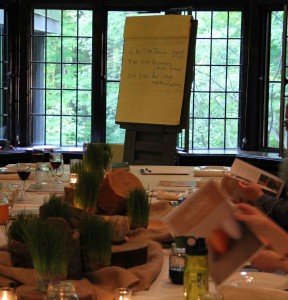
In its new form, the Ethics Table’s first pulse was during the year 2011-2012. The group met daily for a week in August 2011 to explore the idea of a university ethos. Readings included D.H. Winnicott’s Playing and Reality; Dan Scheinfeld’s et al., We Are All Explorers: Learning and Teaching with Reggio Principles in Urban Settings; Martha Nussbaum’s Creating Capabilities; Alice Munro’s Runaway, and the Share the Vision common reading for the year, Justice by Michael Sandel.
The group then met monthly around town — to get out of school, gain perspective and to support local businesses. We ate at the Squirevue Vallee Farm with Spice of Life farm to table catering, at Le Petit Triangle in Ohio City, Club Isabella in University Circle, Prosperity Social Club in Tremont, the Alumni House where we skyped in philosophical counselor Lauren Tillinghast, Empress Taytu in East Cleveland, Café Anatolia in Cleveland Heights, and at the Greenhouse Tavern downtown.
At each of these meetings, two members of the group presented on ethics from their perspective in the university, and a special guest gave a presentation. The special guests this year were Anthony Jack (Cognitive Science), Shannon French (The Inamori Center), Chin-Tai Kim (Philosophy), Laura Hengehold (Philosophy), Lauren Tillinghast (NYU extension branch and private practice), Rhonda Williams (Social Justice Institute), Piers Turner (Ohio State University, Ethics Center), and Dean Moyar (Johns Hopkins University, Philosophy).
Finally, the group convened for a two day retreat in May 2012, with The Montessori School of Cleveland and Roger Saillant (Fowler Center) as special guests at the Inamori Center and at the Manor House of Squirevue Vallee Farm. The group reflected on its future and on the prospect of future developing our university’s ethos. Members of the group also chose to read Simon Blackburn’s Being Good, which was given to all members of the group for their reference.

Betsy Banks, Mark Pedretti, Sue Rivera, and Mary Holmes, Ethics Table Fellows, 2011-2012
Members of the Ethics Table, 2011-2012
- Elizabeth Banks, Director, Center for Civic Engagement and Learning
- Nicole Deming, Assistant Professor of Bioethics, Director of Medical Education, Co-Director, Bioethics Master’s Program
- Sarah Gridley, Assistant Professor of English and Creative Writing
- Mary Holmes, SAGES instructor and local foods entrepreneur
- Megan Jewell, Director, The University Writing Center
- Kenneth Johnson, Graduate student, Affiliate of the Inamori Center
- Kathryn Mercer, Professor of Legal Writing, the Law School
- Mark Pedretti, Lecturer, the Department of English
- Adam Perzynski, SAGES instructor and medical sociologist at MetroHealth
- Rolfe Petschek, Professor of Physics
- Drew Poppleton, Assistant Director for Experiential Learning, the Career Center
- Suzanne Rivera, Associate Vice President for Research and the Department of Bioethics
- Rachel Sternberg, Associate Professor of Classics
- Tracy Wilson-Holden, Director of Research Education
- Jeffery Wolkowitz, Dean of Undergraduate Studies
- Peter Yang, Associate Professor of German
Evolution of the Ethics Table, 2012-2019
Developing from the feedback of the group in 2011, the Ethics Table took on two different forms, (1) the Ethics Table Fellows and (2) the Chat-n-Chew discussion lunches. In 2015, the latter evolved into a community based group as well, spinning off The Moral Inquiries in Cleveland Heights so that there were three versions of the Table operating from 2015-2019. Below are the preserved archives of these.
1. Ethics/Morals Table Fellows (2013-2018)
The Ethics/Moral Table Fellows was a group of students, staff, and faculty selected from an application process that focused on a project to improve the ethical learning environment of Case Western Reserve University. The fellowship was periodic, based on perceived need and interest.
Across the year, the fellows met monthly, reading and discussing ethical theory, working on individual projects, and preparing for an open symposium at the school year’s end. Fellows were given some research money and a stipend or other appropriate form of compensation at year’s end for their work.
a. Ethics Table Fellows, 2013-14
b. Ethics Table Fellows, 2015-16
c. Ethics Table Fellows, 2017-18

Heather Clayton-Terry
–

Emily Dragowsky, 2nd from left, at the Moral Inquiries

Emily Jennings
Emily Jennings is an Accounting Clerk in the Office of Research Administration, Sponsored Projects Accounting and a frequent member of the Ethics Table and the Moral Inquiries. Her project is to help incoming students think about what it means to make an ethical home and empower them to make ethical decisions in their private lives. Illuminating the ethical choices inherent in creating a living space will help student make better choices and improve their lives and their communities. Furthermore, it will help them think of themselves as moral actors capable of changing systems for the better.

Annie Pécastaings
Annie Pécastaings teaches writing-intensive courses at CWRU. Her interests include the Gothic novel and travel literature. Her project focuses on walking with others to build a sense of community. These group walks aim to meet two goals: to cross over the visible and invisible lines that crisscross the city and delineate enclaves; to experience the city as a shared, common ground to which our common fate and stakes are tied. Her work relates to the courses she teaches.

Natalie Snyder

Peter Whitehouse
Peter J. Whitehouse, MD-PhD, is a Professor of Neurology and former or current professor of Psychiatry, Psychology, Cognitive Science, Neuroscience, Bioethics, History, Nursing and Organizational Behavior at Case Western Reserve University, Professor of Medicine at the University of Toronto, and President of Intergenerational Schools International. Peter is a prevention oriented, life course, developmental neurologist. He is the author of hundreds of academic papers and book chapters ranging from genetics, to clinical dementia to public health and bioethics. His project is the design of an intergenerational course on wisdom, aimed for both SAGES and the Siegel Lifelong Learning program.
2. Chat -n- Chew Lunches (2013-2019)
People grow up by learning to speak to themselves, and by learning to speak with each other.
a. 2012-2013 Brown Bag Lunches
b.2013-2014 Brown Bag Lunches
c. 2014-2015 Brown Bag Lunches
d. 2015-2016 Brown Bag Lunches
e. Chat-n-Chew Lunches, 2016-17
f. Chat-n-Chew lunches, 2017-18
In the 2017-2018 academic year, the Chat-n-Chew lunches met approximately once a month on Fridays during Common Hour, starting in January. The Fall schedule involved a hiatus as the Philosophy Common Hour was essayed. The chat-n-chews were open to any member of the campus community.
September 15th, Inamori Ethics Prize panel with Marion Wright Edelman
October 13th, Inamori Center Classroom with Kyle Powys Whyte, 2017 Beamer-Schneider Lecture in Ethics & Civics, “Indigenizing Futures, Decolonizing Our Lands: Indigenous Methods for Transformation”
January 26th, Guilford House Lounge, “Is ‘diversity’ a cop-out word for the task of equality?”
February 23rd,Guilford House Lounge, “The anti-empathy, anti-humane, anti-personal folk”
March 23rd,Guilford House Lounge, “True pragmatism”
April 27th, Guilford House Lounge, “Moral relationships” -a presentation by CWRU students
g. Chat-n-Chew Lunches, 2018-19
First meeting, Friday, October 12th, 12:30-2PM, Clark Hall 104, What Might a “Trans-disciplinary” Grammar Look Like? Ecology, Ethics, and Religion, presented by Bharat Ranganathan
Friday, November 16th, 12:30-2PM, Clark Hall 206, Wonder and Self-Concept: From an Idiosyncratic Trait to Something We May Train Ourselves to Embody, presented by Stormy Sweitzer
Friday, December 7th, 12:30-2PM, Clark Hall 206, A Moral and Ethical Vision for Case Western Reserve University: A Report from Nine Years of the Beamer-Schneider Professorship in Ethics, presented by Jeremy Bendik-Keymer
Friday, February 15th, 12:30-2PM, Cleveland Room, Thwing, Education in the Service of Justice: What CWRU Might Learn from Kolvenbach, presented by Bharat Ranganathan
Friday, March 29th, 12:30-2PM, Cleveland Room, Thwing, with Michael Robinson, Rust Belt Riders
Friday, April 12th, 12:30-2PM, Cleveland Room, Thwing, with Peter Debelak, Soulcraft
g. Chat-n-Chew Lunches, 2019-20
Organized by Bharat Ranganathan, Beamer-Schneider SAGES Teaching Fellow in Ethics
The “common good” holds that each and every person is entitled to share in society’s resources. Moreover, each and every person is also responsible for sharing out society’s resources—the common good—with one another. This commitment to the common good extends beyond not only our personal interests but also our national borders; it extends to our one global human family. Based on the belief that we experience the fullness of life in our relationships with others, working toward the common good requires a commitment from each and every person to respecting the rights and responsibilities of all people.
How does the common good relate to Cleveland? On the one hand, Cleveland is a large and growing metropolitan area, with renowned hospitals, museums, national parks, and universities. On the other hand, Cleveland is best by economic, political, and social problems. During the 2019-2020 academic year, the Ethics Table will meet to explore various social issues that affect the common good, including: food scarcity; the degradation of the Cuyahoga River and the Great Lakes; and racial and income gaps. In conversation with speakers from the Cleveland area, we will further explore the concrete steps they are taking to address these issues, from reimagining what counts as a community to developing a sense of place.
In addition to conversations over lunch, there will also be opportunities to visit and volunteer with the various speakers.
For more information, or to be put on an announcement list, please email bxr38@case.edu .
3. The Moral Inquiries ~ a Heights gathering (2015-19, 4 yrs. 6 months)
The Ethics Table generated a group that mets in the historic Coventry neighborhood of Cleveland Heights at Mac’s Back’s Books, the much-loved independent bookstore that adjoins Tommy’s. Called “The Moral Inquiries ~ a Heights gathering,” this community group discussed moral issues and was co-organized with members of the community.
Over its four years and six months, the group hosted or co-hosted over 110 meetings, included over 200 members, and involved more than a hundred people in semi-regular discussions in line with its philosophy of an “emerging curriculum.” For instance, in 2016, the group found itself studying and discussing being a democratic citizen for over half a year as the General Election approached and then debriefing about the election afterward. The group also often discussed global warming, responsibility for mass scale social problems, and obligations to future generations.
The oldest member of the group was 95 and the youngest attendee ever was less than six months. Participants came from the Cleveland region sometimes as far out into the townships and were from all walks of life. In addition, a sizable number of CWRU faculty, students, and alums participated at different times.
The group disbanded in 2019 due to its lead organizer needing to care for a newborn.

Members of the Ethics Table at the Moral Inquiries, Mac’s Back’s Books, Cleveland Heights, 2017