October 2006

Interim president updates alumni on budget, other important matters

To: All Alumni

From: Gregory L. Eastwood, M.D., MED'66, Interim President


Dear Alumni,

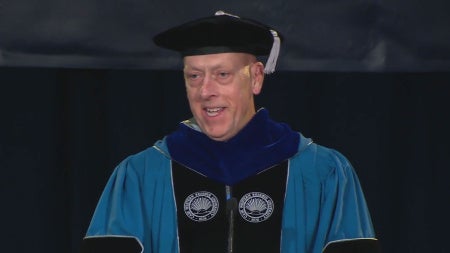
I recently gave my State of the University address on campus to faculty and staff and thought it might be helpful to share with you this update about the financial situation and other matters of importance to Case Western Reserve University that I covered during that address. First, however, because I feel accountable not only to the Board of Trustees but to everyone to whom this is addressed, I would like to review some of what I have been doing since my arrival as interim president June 2.


The past four months have been busy and rewarding. I have appreciated the warm welcome and expressions of support from everyone—trustees, faculty, staff, students, alumni, and community leaders. Lynn and I moved into the president's residence on Harcourt Drive in Cleveland Heights in early June. We have enjoyed living there, getting to know the neighbors, and hosting various events. We also have taken advantage of the cultural and entertainment offerings of this area (Blossom Festival, Cleveland Playhouse, the Cleveland Indians), and I have benefited from numerous meetings with students, faculty, and staff on campus as well as with alumni and other supporters in this community and at several locations around the country. The uniform response is, "I want Case Western Reserve University to thrive. How can I help?"

I am guided in my interactions with you by several principles. First, I believe in "Open Communication" and "Structured Action," terms I borrowed from Jim Wagner, president of Emory University, and which express my own views. Open Communication means that anyone can talk with anyone else. Structured Action means that actions should be taken by the person empowered to take them. The president or a dean should not be doing things that others are supposed to be doing. A related principle is listening. Listening is an active endeavor. It is how we learn things and informs our actions. Also, in keeping with the observation of the great French physiologist Claude Bernard who said, "Chance favors the prepared mind," listening means that we try to be receptive to all information and alert to how it relates to the issues with which we are dealing. Another key element in my thinking is that this time of interim presidency (or deanship, or whatever) must be a time of action and progress. We are a great university that has had some challenges recently, but we have remarkably talented faculty and staff, enthusiastic students, and eager supporters everywhere, and we cannot afford to delay until the next permanent leader is here, whether at the university or a school.

The Financial Condition of the University

During my State of the University address I pledged that "I will keep you informed of the financial condition of the university and other important matters throughout this year." I will do this by providing updates such as this and by meetings with faculty, staff, students, alumni, and friends throughout the year. The following is a current update on the university's financial position.

Last spring, as the university leadership looked at the current fiscal year (July 1, 2006-June 30, 2007), we anticipated a budget gap of about $50 million, on a university operating budget of about $830 million. You recall that the Vision plan called for planned deficit spending for several years, borrowing from the university's working capital as well as a line of credit. The plan also called for a return on this investment by increasing research grant revenues and philanthropy. Although research grant income has increased a small amount, it is below expectations because of national trends in research funding, and our philanthropic giving has diminished. It became evident last year that we would need to reduce expenditures because increases in income would not be sufficient to allow the university to return to a stable operating budget. Thus, rather than a $50 million deficit for the current fiscal year, by severe cost cutting, which included some painful layoffs, we were able to reduce the projected deficit to about $10.5 million. We plan to close the deficit entirely next fiscal year (July 2007-June 2008).

We began the current fiscal year (July 1, 2006-June 30, 2007) with a planned deficit of $10.5 million. Based on our early assessment of the current fiscal operation, the budget continues to be tight in the schools of Medicine, Engineering, and Management. However, it is too early in the year to draw predictive conclusions. We will do everything possible to achieve our budgeted target. Despite the tightness of the budget, there are several positive signs.

  • Overall spending is lower than last year due partly to the budget reductions last year.
  • Total year-to-date dollars for sponsored research activity, as measured both by proposals and awards, have trended up slightly.
  • Net tuition revenue appears on target.

Unfortunately, philanthropy, another important source of revenue so vital for the university's long-term financial stability, is continuing to trend down, although Annual Fund revenue seems to be tracking on budget. However, there are reasons to remain optimistic about future fundraising. Improved relationships with our key constituents, including the Case Alumni Association, seem to be moving in the right direction.

The university's combined endowment is about $1.6 billion. An outstanding endowment performance contributed to a $97.5 million (5 percent) increase in total net assets of $2.0 billion. The pooled endowment (a large portion of the combined endowment) generated a return of 14.3 percent, which is slightly below the first quartile of the Cambridge Associates' College and University endowment universe for the fiscal year. The pool also had competitive returns over longer times, generating compounded annual total returns of 15.44 percent and 9.16 percent for the three and five year periods ended June 30, 2006. This performance places Case Western Reserve University in either the first or second quartile for all reporting periods. The combined endowment generated a total return of 13.2 percent in fiscal year 2006.

Students

The university made a strategic decision several years ago to expand the undergraduate student body and implement several initiatives, including SAGES and the new residential Village at 115. The entering class size has increased (2004 = 784, 2005 = 1,162, 2006 = 1,015) and the corresponding SATs are 1308, 1334, 1317. Although it would seem that there is a direct relationship between class size and SAT, the relationship is very complex and includes variables such as discount rate, selectivity, and differences from school to school. This is something we can discuss at our face-to-face meetings. This year, 7,479 students applied for the entering class, a record high. In keeping with our intent to be a national university, 56 percent of the entering class now comes from outside of Ohio, compared with 49 percent last year. Also, this year's entering class is comprised of 43 percent women, a record high, up from 39 percent last year. The ethnic distribution is Caucasian 63 percent, Asian 22 percent, African-American 6 percent (a modest improvement over last year), Hispanic/Latino 2 percent, Native American <1 percent, Other/Unknown 7 percent.

As we continue to attract a diverse and talented student pool, our scholarships are of great importance, and gifts to our scholarship programs are vital. The university has renewed its partnership with the Cleveland Scholarship Program (CSP), which is intended to attract 50-60 low-income students from the greater Cleveland area to this university. Each of these students will receive a scholarship of up to $1,500 from CSP and subsidies from Case Western Reserve of $5,500 per year. By doing this, we seek to meet a need in our community and strengthen the university in the process.

Leadership

Four schools have experienced or will experience a change in dean during the period July 1 through December 31, 2006. The deans involved are Mark Turner (College of Arts and Sciences), Myron Roomkin (Weatherhead School), Ralph Horwitz (School of Medicine), and Bob Savinell (School of Engineering). I am grateful to each for his leadership and stewardship of his school. To replace them, we have appointed remarkably capable people: Cyrus Taylor in Arts and Sciences, Mohan Reddy in Weatherhead, and Pam Davis in Medicine. Each, in my opinion, is comparable in stature and ability with deans at other prestigious universities. We are now conducting searches, confined to internal candidates, to name permanent deans in the College of Arts and Sciences, the Weatherhead School, and the School of Engineering. The search for the permanent dean of the School of Medicine will begin after the permanent president is named. There is broad support for all three interim deans from within and without their schools and they all appear to be leading their schools in exemplary fashion. I also must emphasize that, during this time of change in several schools, I have reassured the deans and faculties of the other schools (Dental Medicine, Applied Social Sciences, Nursing, Law) that I value them highly and continue to depend on their leadership and support.

The "Case" Brand Issue

Although for many years people have referred to this university as "Case," about four years ago the Case wordmark and logo were introduced on letterheads, signage, publications, banners, and so forth. This seems to have become a convenient moniker for high school guidance counselors, students, community people, the press, and others. However, a sizeable number of others, including many graduates of Western Reserve University, are offended by this and have withheld donations and expressed concern that the Western Reserve history and legacy have been obscured. It is very important that we address this openly and constructively. Thus, a small task group, led by trustees Tim Callahan and Ted Schroeder, has been reviewing this matter and will present a progress report to the Board of Trustees at the October 20-21 meeting.

Diversity

Because of the importance of diversity to this university, I recently created a personal statement that expresses my views on the subject, which I will share with you:

"We seek to establish a diverse, inclusive, and respectful environment at Case Western Reserve University and in all interactions outside the university. I envision a distant time when diversity is so integral to our culture that we do not feel the need to address problems or issues with regard to it. However, that is an impractical, unrealistic vision for the present time. Rather, my vision is for a near future when everyone IS aware of diversity and thinks and acts to promote diversity.

"The task at hand is to resolve how we make attention to diversity an essential and primary function of everyday life at Case Western Reserve University and not simply something that we create statements about and relegate to policies and procedures and advisory committees. Part of the solution is to create an expectation for diversity that begins with me and is driven throughout the people of this university by expectations, programs, and practices that promote diversity."

What Does It Mean To Be a Great University?

A great university has a purpose. I think the purpose of Case Western Reserve University is to improve the lives of people in our local, regional, and world communities through education, research, and service. With regard to the question, "What does it mean to be great university?" I had the good sense to ask our deans, and here are some of the things they said:

"A great university is a driver of new information." "…is paradigm-shifting." "…is out to make a change." "…has an effect on society." "…is visionary, ahead of the rest." "…has good leadership." "…can't be great in everything." "…has tradition and long-term commitment." "A great university's graduates change the world."

I believe that a great university changes the world and everyone associated with the university does it—graduates, faculty, staff, students, friends. The world we change may be within our university, next door in our community, in our region, across the country, and around the globe. If the people of Case Western Reserve University aspire to change the world, this will be a great university. I invite you to support this university in any way you can, to create a great university, and to change the world.


ALUMNI HOME  ALUMNI EVENT CALENDAR    CONTACT US   ALUMNI@CASE 

If you do not wish to receive email communications from Case Western Reserve University,
please send an email to devemail@case.edu with "remove" in the subject line.