******************************************************
Tibetan Studies Internet Newsletter
Vol. 1, #3
April 15, 1999
******************************************************
Published by The Center for Research on Tibet
Case Western Reserve University
Cleveland, Ohio 44106, USA
Melvyn C. Goldstein, Director
Compiled and Edited by Melvyn C. Goldstein
******************************************************
**To Subscribe to TSIN:
Send an e-mail to majordomo@po.cwru.edu with the following message (do not
include brackets):
subscribe tsin [your e-mail address]
**To Unsubscribe to TSIN:
Send and e-mail to majordomo@po.cwru.edu with the following message (do not
include brackets):
unsubscribe tsin [your e-mail address]
**To submit materials, including letters to the editor: Send an e-mail to
tibet@po.cwru.edu with
your submission
**To Change a Subscription Address: Unsubscribe to TSIN, and then
Resubscribe with the new address
**Past issues can be found archived at the Center for Research on Tibet
website: http://www.cwru.edu/affil/tibet/
******************************************************
Contents:
I. Research News: Austrian-Tibetan initiative; TTP
II. Guest Book Review Essay: Education in Tibet. Gerald Postiglione
III. New Ph.D. Dissertations: "Buddhism Observed: Western Travelers,
Tibetan Exiles, and the
Culture of Dharma in Kathmandu"
IV. Conference, Seminar and Co-operation News
V. New Books
****************************************************************************
I. Research News
1. From the Alps to the Himalayas: an Austrian initiative for
interdisciplinary research in Tibet
Hildegard Diemberger and Monika Kriechbaum
In 1992 a small group of anthropologists gathered in Vienna and formulated
an ethnographic research project on Sacred Mountains in Tibet and the
Tibeto-Burman following the tradition of the Austrian scholar Rene de
Nebesky-Wojkovitz. Under the leadership of Prof. Andre Gingrich, the
project was affiliated to both the Institute of Social and Cultural
Anthropology of Vienna University and the Austrian Academy of Sciences
through Prof. Ernst Steinkellner (Institute for Tibetology and Buddhist
Studies, University of Vienna). On the basis of a series of successful
joint pilot projects, in 1995 an official agreement of co-operation was
signed with the Tibetan Academy of Social Sciences. This facilitated
regular fieldwork in Tibet and allowed Tibetan colleagues to make longer
visits to Austria to carry out joint research work. Thanks to the discovery
of a significant number of important historical works, the original focus
of the project gradually developed towards a deeper concern with literary
sources and with the interaction between literary and oral traditions. Some
of these historical sources have been translated and published jointly by
the Tibetan Academy of Social Sciences and the Austrian Academy of Sciences:
Pasang Wangdu, H. Diemberger, G. Hazod, 1996, Shel dkar chos 'byung:
History of the "White Crystal". Wien: Verlag der Österreichischen Akademie
derWissenschaften.
Tsering Gyebo, Guntram Hazod, Per Soerensen (forthcoming), Civilization at
the Foot of Mount Shampo - An Annotated Translation, Transliteration and
Facsimile Edition of Historical Documents from g.Ya' bsang. Wien: Verlag
der Österreichischen Akademie der Wissenschaften.
Pasang Wangdu and Hildegard Diemberger (forthcoming), The Chronicle of the
dBa': Annotated Translation and Facsimile Edition of the dBa' bzhed, "the
Royal Edict on how the Dharma came to Tibet" (provisional title). Wien:
Verlag der Österreichischen Akademie der Wissenschaften.
Meanwhile the study of representations and rituals regarding sacred
landscape was developed further in co-operation with Centre d'Etudes
Tibetaines, Paris. Within this framework two collections of essays
presenting new ethnographic material and literary sources were published:
A.-M. Blondeau and E. Steinkellner (eds),1996, Reflections of the
Mountain:Essays on the History and Social Meaning of the Mountain Cult in
Tibet and the Himalaya. Wien: Verlag der Österreichischen Akademie der
Wissenschaften.
A.-M. Blondeau (ed.), 1998, Tibetan Mountain Deities, their Cults and
Representations. Wien: Verlag der Österreichischen Akademie der
Wissenschaften.
Since 1997 a closer co-operation with the Centre of Environmental Research
and Nature Conservation, University of Agricultural Sciences, Vienna, has
added an interisciplinary dimension to the research by focusing on the
relationship between perceptions of landscape and territory as well as its
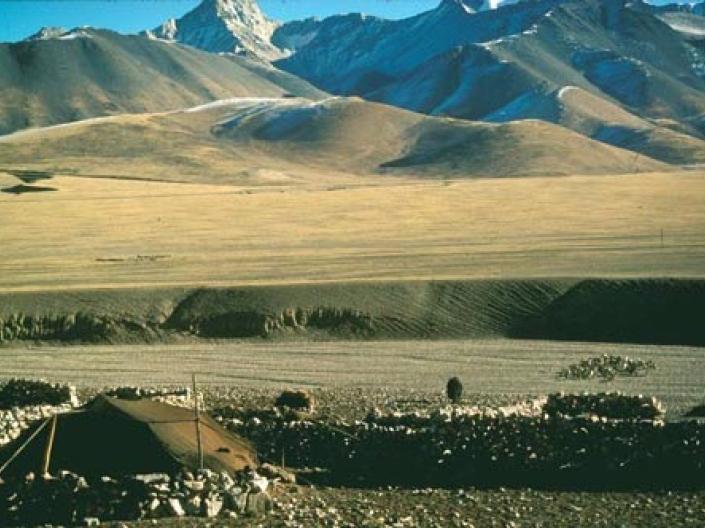
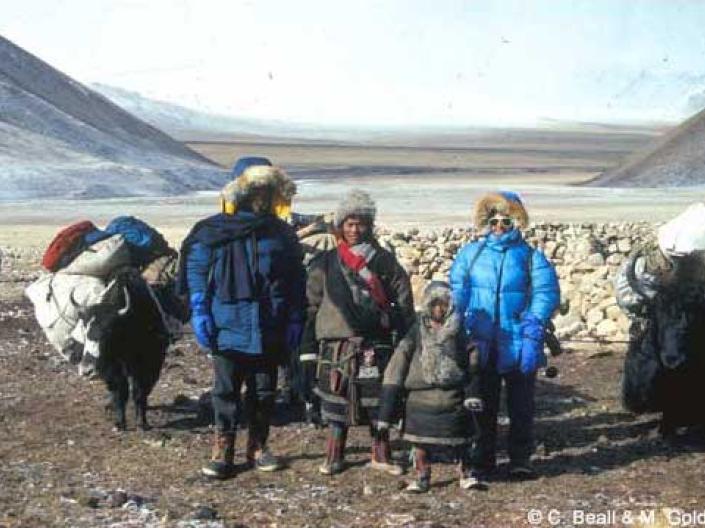
concrete management. This has resulted in a project focusing on pastures
and nomadic communities, especially in the area of Porong and Nagchu, in
co-operation with the Lhasa-based government department, "Tibet Assistance
to Remote Areas". A detailed study of the pastures, their botanical
composition, their general condition and how these correlate with past and
present patterns of pasture management is currently being carried out.
Special attention is paid to the changes which have occurred in the
transition from traditional patterns to the present ones and to the
assessment of concrete problems affecting this area, just as in many other
areas in Tibet: drought, overgrazing, snow-disasters, etc. For the purpose
of these studies co-operation between natural sciences and social sciences
is essential, as the nomads are part of the ecosystem. An analysis of the
interdependences within the pasture ecosystems is a precondition for an
applied ecological approach. The multidisciplinary team tries to combine
traditional pastoral knowledge with ecological, economic and social
considerations as part of its goal of contributing towards optimal
utilization of the pastureland.
Part of the research activity dealing with concrete problems of the nomadic
communities is being carried out together with Eco-Himal, an NGO based in
Austria, Italy and Switzerland, that supports small projects initiated by
the various local communities in the field of culture, education,
infrastructure and emergency relief.
At present the anthropological team consists of: Andre Gingrich, Charles
Ramble, Guntram Hazod, Hildegard Diemberger, Gabriele Tautscher, Christian
Schicklgruber, Christian Jahoda Kirsten Melcher.
The team for vegetation ecology consists of Wolfgang Holzner and Monika
Kriechbaum.
2. The Tibetan Plateau Project (TPP)
The TPP mission is to promote the conservation of biodiversity and the
sustainable development of mountain communities in the greater Tibetan
Plateau region, which includes portions of Bhutan, China, India, Nepal,
Pakistan and Tibet. TPP's campaigns emphasize regional strategies for
biodiversity conservation and economic development that benefit local
people and inform the international community about environmental threats
facing the region.
Among TPP's goals are to:
Safeguard regional ecosystems by supporting conservation strategies,
land-use practices and development goals that protect biodiversity. Act as
an information clearinghouse providing easily accessible background on the
countries and conservation issues relevant to the region. Protect wildlife
and plant resources in the Tibetan Plateau region by promoting research and
strengthening international, U.S. and foreign conservation laws and
policies. Develop resources for supporting the conservation of medicinal
plants used in Tibetan and other traditional medical systems. Inform the
public, activists, policymakers and academics worldwide about the relevance
of conserving biodiversity in the Tibetan Plateau region.
TTP is also about to launch , an email listserver
dealing with the relationships between the conservation of medicinal plants
and the practice of Tibetan medicine.
****************************************************************************
***
II. Guest Essay-Book Review:
Doing Educational Research in Tibet
Gerard A. Postiglione
Department of Education
The University of Hong Kong
The late Dr. Ernest Boyer one remarked that the only constant in
educational research is the continuity of ambiguity. He was remarking about
the mammoth research establishment dedicated to examining education in the
United States. If this is the case, how are we to think about educational
research done in other lands, especially developing countries, where there
are few skilled and experienced educational researchers at work, and most
are from outside the land in question. Not long ago this was the case in
China. If one was lucky to gain access, the result was often a book length
work. Looking back, what can we say about some of those works? How much is
the Tibet of today like pre-1978 China? Though Tibet is part of China,
there has been next to no educational research published in English, and
even the amount in Chinese and Tibetan has been shallow. Descriptions,
exhortations, and speculation abound. Thus, it takes a brave Western spirit
to write a book on education in Tibet, when virtually every Western
education journal is void of even an article on the subject of education in
this land that gets more media coverage than most countries of the world.
Catriona Bass has taken up this massive challenge and with the support of
the Tibet Information Network and Zed Press put out a volume on educational
policy and practice since 1950 ("Education In Tibet: Policy and Practice
Since 1950", 300pp, ISBN 1 85649 674 0). The volume is clearly written with
all the conventions of a textbook. If there were a college course entitled
Education in Tibet 101, this could be the volume for students without
previous knowledge on the subject. Though without a competitor, the volume
can be said to contain a fair introduction to the subject. Key issues,
including bilingual education, teacher training, educational finance, etc.
are covered. Each chapter contains an account of the basics, placed in the
context of the national educational policies of the PRC. The text is based
upon data from newspapers, yearbooks, local journals, the odd internal
circulation document, and random interviews. The most substantial chapter,
which covers primary education, contains a description of enrolment,
dropout, and literacy rates, as well as other anecdotal material. Noting
that low enrolment is a major problem in primary education, the chapter
concludes that, "The causes of low enrolment appear to be a combination of
financial and cultural factors." Beyond this, what can we learn? The
complexity of village life is elusive.
It is not surprising that this book is high on policy and low on practice.
In a place where access is severely limited, data sources are not
plentiful. Most data sources contains some basic information, but little
about the debates underlying the issues. Could we expect more from
government publications? Articles written by officials who are periodically
sent down to examine policy implementation contain reports and stories told
to them by the local authorities. How reliable are the stories and
statistics? How are we to understand the thinking of local Tibetan herders
and farmers about schools for their children when few are literate and
contact with them is difficult? Many a teacher of English in China has
written articles on education in China. How much access does a teacher of
English gain to Tibetan perspectives? A daunting task, indeed. A certain
amount can be learned from the increasingly available, though often
unreliable regional statistics. However, this data does not permit us to
understand the manner in which Tibetan students and their families come to
construct the meaning of schooling within their own communities. How
autonomous were the decisions about attending or dropping out of school? To
what degree do Tibetans differ from other ethnic groups in China in their
cultural adaptation to state schooling? How relevant are cultural
resistance and cultural discontinuity to understanding success and failure
for Tibetans in school? We know families find it difficult to pay school
fees, and for Tibetan families this often means fees for more than one
child. How do Tibetan families select which of their children will become
their key educational investment? How high do book fees have to be before
parents pull their children out of school? Under what conditions would they
consider supporting the decision to discontinue the schooling of their
daughters? It what way do schools and religious institutions represent
ethnic minority culture in differing ways, thus creating competing
identities. How do Tibetans and deal with the dual layers of representation
of their identities that result from their socialization in state schools
and other educational institutions (family, monastery, village community,
etc.)? It seems we have a long way to go before understanding education in
Tibet.
****************************************************************************
***
III. New Ph.D. Dissertations
1. Peter Kevin Moran , "Buddhism Observed: Western Travelers, Tibetan
Exiles, and the Culture of Dharma in Kathmandu."Ph.D. Dissertation, Dept.
of Anthropology, University of Washington, 1999.
This study examines the encounter between Western travelers and Tibetan
exiles in the community of Bodhanath, on the outskirts of Kathmandu, Nepal.
Their contact is informed by powerful spiritual and nationalist longings
that pervade contemporary discourses surrounding "Tibet" and "Buddhism." I
have specifically focused on the ways in which Tibetan Buddhism has been
presented as an object to be observed, reflected upon, and internalized by
Western travelers as they meet with Tibetans-in-exile. What this study
documents is the changing nature of Buddhist subjectivities, whether
Western or Tibetan, in the context of pilgrimage, tourism, and exile.
The analysis proceeds on the basis of anthropological fieldwork carried
out in a very specific locale, but I also demonstrate that Bodhanath is the
site of wider cultural disjunctures, national displacements, and economic
flows that have shaped the contact between Tibetans and Western interested
in Buddhism. Thirty years ago, Bodhanath was an agricultural and sparsely
populated community. Today it is a Tibetan boomtown, with more than twenty
Tibetan monasteries in close proximity to residential flats and a tourist
market.
I trace the processes by which Tibetan Buddhism has become Bodhanath's
cultural product par excellence. "Tibet" and "Buddhism" become not only
sights for foreign tourists to see, but, for some of them, objects to be
internalized through study and meditation at the feet of Tibetan lamas. By
examining the often invisible assumptions that undergird the perception of
Tibetan Buddhism, I shed light on the practices and narrative structures
through which seemingly "natural" Tibetan and Western Buddhist subjects are
produced. Thus this study focuses on the differentiating practices and
discursive formations through which Westerners and Tibetans have understood
not only what it means to be "Buddhist," but what it means to be hailed as
one from "the West" or from "Tibet
****************************************************************************
***
IV. Conferences, Seminars, Cooperation Requests
1. Matthew Kapstein and Melvyn Goldstein are interested in organizing a
Roundtable for next year's Association of Asian Studies Meetings on the
topic of TIBET IN HIGHER EDUCATION. Readers interested in participating
should contact either Kapstein at (mkapstei@midway.uchicago.edu) or
Goldstein at (mcg2@po.cwru.edu).
2. Seeking Reviewers for "A READER OF CLASSICAL TIBETAN"
Matthew Kapstein, at the University of Chicago, is currently developing a
reader of classical Tibet. The text is designed to be used by students who
have completed an introductory course in literary Tibetan, and know the
basic elements of morphology and syntax. It includes selections
representing a broad range of topics and genres: history, poetry, religion
and Buddhist philosophy, among others. In its final form, the reader will
include a complete glossary and annotations concerning difficult points.
Some chapters of the reader will be completed in draft form by the end of
the summer, and so will be ready for use in the fall term, 1999. Those who
would like to have access to these materials
as they become available should contact the author directly at
m-kapstein@uchicago.edu.
The conditions governing use of the draft material will be:
1. that it not be reproduced or distributed except for the use of those
studying Tibetan with you in the 1999-2000 academic year.
2. that you report back to the author regarding your experience using the
material for instruction, with suggestions for improvement as needed.
****************************************************************************
***
V. New Books
1. John Kenneth Knaus. Orphans of the Cold War: America and the Tibetan
Struggle. New York: Public Affairs, May 1999, ISBN 1-891620-18-5.
2. Tsering Shakya. The Dragon in the Land of Snows. London: Pimlico Press,
1999, ISBN 0-7126-6533-1.
****************************************************************************
***
© 1999 The Center for Research on Tibet
Text is not to be used without written permission.
http://www.cwru.edu/affil/tibet/
|