******************************************************
Tibetan Studies Internet Newsletter
Vol. 3, #1
August 2003
******************************************************
Published by The
Center for Research on Tibet
Case
Western Reserve University
Cleveland,
Ohio 44106, USA
Melvyn C. Goldstein, Director
Compiled and Edited by Melvyn C.
Goldstein
******************************************************
**To Subscribe to TSIN:
Send an e-mail to
majordomo@po.cwru.edu with the following message (do not include brackets):
subscribe
tsin [your e-mail address]
**To Unsubscribe to TSIN:
Send and e-mail to
majordomo@po.cwru.edu with the following message (do not include brackets):
unsubscribe
tsin [your e-mail address]
**To submit materials, including
letters to the editor: Send an e-mail to tibet@po.cwru.edu with
your
submission
**To Change a Subscription
Address: Unsubscribe to TSIN, and then Resubscribe
with the new address
**Past issues can be found
archived at the Center for Research on Tibet
website: http://www.cwru.edu/affil/tibet/
******************************************************
Contents:
Editor's comment
I. New Publications
II. Websites and collections
III. New Dissertations
********************************************************************************
I. NEW PUBLICATIONS:
1.
Kenneth Conboy and James Morrison. The
CIA’s Secret War in Tibet. U. of Kansas Press, 2002.
2. Thomas Laird. Into Tibet: The
CIA’s First Atomic Spy and His Secret Expedition to Lhasa. N.Y. Grove Press, 2002.
3. Ann Frechette.
Tibetans in Nepal: The
Dynamics of International Assistance Among a Community
in Exile. Berghahn Books, 2002.
4.
F. Pommaret (ed.) Lhasa in the Seventeenth Century:
the capital of the Dalai-Lamas.
Tibetan Studies Library, Brill, Leiden-Boston,
2003.
ISBN
90 04 12866 2
Before 1642, Lhasa was a small town, renowned
for its Jokhang temple and the three large Gelukpa monasteries built nearby in the
15th century, but it had neither the status nor the fame of a capital. The political victory of
the Gelukpa changed its destiny and it was through the will of the Fifth Dalai
Lama
that Lhasa became the centre of the Tibetan world, with its influence
reaching as far away as Mongolia and Ladakh.
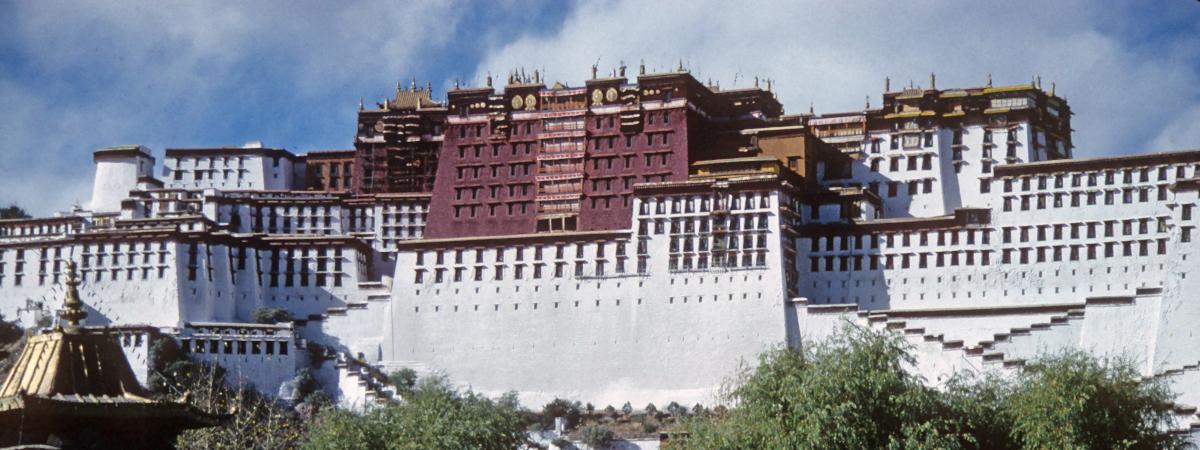
The small town was transformed into a capital adorned with prestigious monuments, of which the Potala Palace was
the focus and the symbol.
This book, based on Tibetan and Western
sources and written by specialists, provides a fascinating study of the history of Lhasa against the background
of
the triangular relations Tibetans-Mongols-Manchus.
The articles explore the
different facets of the historical, political and cultural context of
the
17th century Lhasa and finally allow the reader
to understand Lhasa in the
contemporary Chinese framework.
II. WEBSITES AND
COLLECTIONS:
1.
News from the Namgyal Institute of Tibetology (NIT), Gangtok, Sikkim
Since
its establishment in 1958, the NIT has sponsored and promoted research on the
religion, history, language, art and culture of the people of the Tibetan cultural
area which includes Sikkim. The NIT's
library holds one of the largest collection of Tibetan
works in the world outside Tibet and a museum of Tibetan iconography and religious
art. It has published the Bulletin of Tibetology
since 1964 and numerous books over the years.
The
site on which the institute was established was donated by the late Chogyal (king) of Sikkim Sir Tashi
Namgyal in memory of his departed son Paljor Namgyal. The foundation
stone of the institute was laid by the 14th Dalai Lama on the 10th of February 1957 and the institute was declared open by the
late Prime Minister of India Pandit Jawaharlal Nehru
on the 1st of October 1958. The building of the
institute is an imposing monument and a splendid example of Sikkimese
architecture.
In
the summer of 2002, the NIT's new director, Mr. Tashi Densapa, has undertaken to
expand the institute, restructure its research wing and open its doors to international
collaboration. This will be done through the creation of new research programs,
monthly lecture series, seminars, language classes, fellowship programs,
publications and collaboration with foreign scholars. It is hoped that the
institute will actively promote Tibetan studies, including its sub-field of Sikkimese studies, and become a dynamic research centre in
the Eastern
Himalayas. In order to help him achieve this, Mr Densapa has appointed Tashi Tsering (Amnye Machen Institute, Dharamsala) as
part-time Consultant and Anna Balikci Denjongpa (PhD London) as Research-Coordinator.
From
its publication department, the NIT has decided to translate and publish some
of its rare manuscripts, histories of Sikkim and sacred guide-books in
order to make them available to a larger public. Among its new research
programs, the NIT's Research Officers have undertaken
a project to document the social history of Sikkim's 60-odd monasteries in order
to publish an illustrated book on the subject. A second project proposes to
locate, digitalize and document old and rare photographs of Sikkim, both in India and abroad. The aim is to
create a digital image bank at the NIT and organize a permanent photographic
exhibition. The NIT is also establishing a visual anthropology project in order
to produce an enduring digital record of Sikkim's vanishing indigenous and
Buddhist cultures.
An
international inter-disciplinary seminar on Sikkim will be held at the
institute towards the end of 2003 in honour of famous
Sikkimese scholars in Tibetan studies. Scholars
interested to participate should contact the NIT on: nitsikkim@yahoo.co.in.
It is hoped that the seminar will generate interest in Sikkimese
studies and facilitate the establishment of an international association for Sikkimese studies based at the institute.
The
NIT will soon undergo a general expansion of its infrastructure and facilities.
The construction of a new building which will house a library, study rooms, a
conference hall, studios and an administrative wing is to begin before the end
of the year. A grant to modernize the NIT's
exhibition hall has been approved by the American International Centre, India.
The
NIT’s new web-site www.tibetology.com is still under
construction but please visit the site for further information about the
institute and its activities in the future.
2. The Himalayan Page http://himalaya.pagina.nl/
has an English mirror site at: http://himalaya.start4all.com/
3.
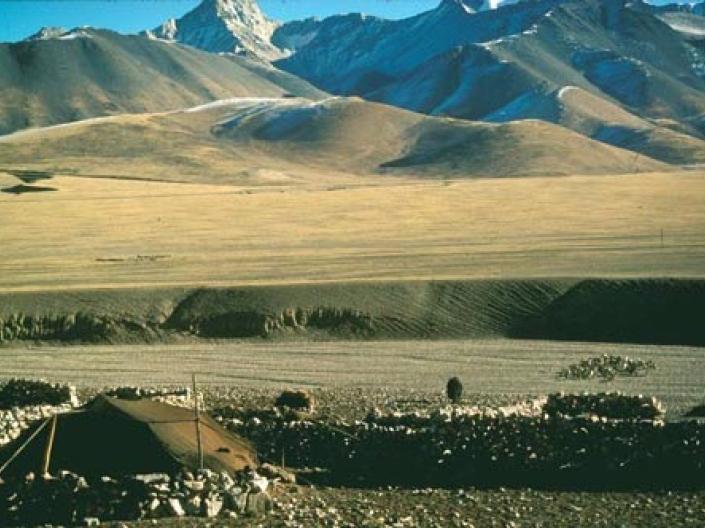
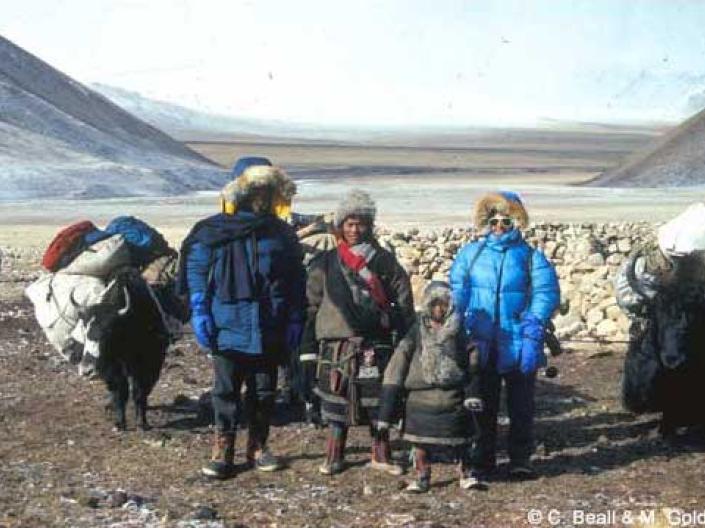
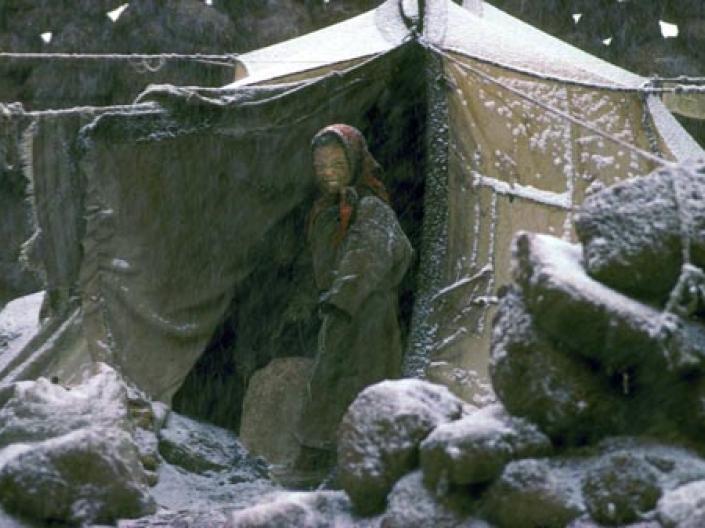
The Center for Research on Tibet has expanded its content
on Tibetan society. In particular, it is developing an extensive section on
Tibetan pastoralism and related topics. See: http://www.cwru.edu/affil/tibet/.
Scholars who wish to add their own articles, reports or out-of-print books
on Tibetan nomads should contact the Center.
4. NEW from the Tibetan
Buddhist Resource Center.
III.
NEW DISSERTATIONS:
1. Hess, Julia Meredith.
“Stateless citizens: Culture,
nation and identity in the expanding Tibetan diaspora,"
THE UNIVERSITY OF NEW MEXICO, 2003, Ph.D.
Abstract
The Tibetan diaspora has
expanded dramatically in North America since the passage of the
1990 Immigration Act. The act included legislation that allowed 1,000 Tibetans
living in South Asia (India and Nepal) to resettle in the U.S. with immigrant visas. The
dissertation examines this migratory movement and the attendant transformations
in expressions of Tibetan identity in diaspora. Part
One of the dissertation places the expansion of the diaspora
in historical and geopolitical context, exploring the range of state policies
that have impacted diasporic Tibetans. I discuss
discourses deployed by the Tibetan government-in-exile (a non-state) to
articulate the "Tibet issue" in an
international arena composed of states. In particular, I examine the slippage
between "culture" and "nation" employed by the
government-in-exile and Tibetans in general. Discourses about Tibetan identity,
culture and nation intersect with state policy in the production of diaspora consciousness which characterizes
Tibetan exile identity. Part Two of the dissertation examines the
establishment, organization and responses to the Tibetan-U.S. Resettlement
Project (TUSRP) when it began in the early 1990s. I divide the majority of
responses to the TUSRP into three categories--the impact on the future of the
political movement to gain some measure of autonomy or independence for Tibet, the economic impact of
increased migration, and concerns about culture preservation and loss. Part
Three of the dissertation, "Tibetans in the United States," focuses primarily on
data collected in the New Mexico "cluster site" of
the TUSRP. Tibetans resettled in the U.S. with a perspective on
Tibetan identity and culture shaped by formalized schooling in South Asia that steeped them in
modernist perspectives of "nation" and "progress." Tibetan
nationalist ideology serves as a strong foundation for their identity as
members of a diasporic community. Migration to the
West is conceptualized as a patriotic act, enabling individuals to better
support the Tibetan cause. Tibetan youth are developing a
"cosmopolitan" outlook that emphasizes political activism, global
awareness and transnational mobility. Yet, both adults and children express
concerns and hopes about the impact of U.S. resettlement on Tibetan
identity in the years to come.
2. Jorden, Ngawang. "Buddha-nature:
Through the eyes of Go rams pa Bsod nams seng ge
in fifteenth-century Tibet," HARVARD UNIVERSITY, 2003, Ph.D.
Abstract
This dissertation explores the evolving
interpretation and understanding of the Buddha-nature in Fifteenth-Century
Tibet, through the eyes of Go rams pa Bsod nams seng ge
(1429-1489), a prominent scholar of the Sa skya
school of Tibetan Buddhism. The previous work of European and American scholars
in this field have led to our general understanding of Buddha-nature as an
innate potential for enlightenment that lies within all sentient beings. The
concept of Buddha-nature provides the primary answer to a question with which
all Mahäyänists have been philosophically concerned,
throughout history: are all sentient beings capable of attaining Buddhahood? The Mahäyäna, more
specifically, Madhyamaka theory of Buddha-nature
answers the question unequivocally: "Since all sentient beings possess
Buddha-nature they are guaranteed to achieve the state of Buddhahood."
This research has been mostly limited to the interpretations of Indian and
Chinese texts and to a study of only certain Tibetan schools. This dissertation
seeks to fill the gap in present scholarship by analyzing the systematic
thought of Go rams pa, who set out to provide a critical analysis, explain the
internal coherence, and map out the organization of diverse Indian and Tibetan
interpretations of this complex idea. I demonstrate in two fundamental ways
that Go rams pa developed an unique view of
Buddha-nature in two ways: First, I explore the facts Go rams pa's
interpretation of Buddha-nature that contribute to his unique perspective.
Second, I analyze his opponents' views on the subject thereby illuminating its
distinctive features in an historical context. Throughout this study, I deploy
a comparative apparatus considering the different views that Go rams pa thought
was wrong. Given this fifteenth-century debate, we realize that the
understanding of Buddha-nature is subtle and complicated; yet this study is
vital to explicate its implications. I conclude that according to Go rams pa,
Buddha-nature is to be understood as unity of the emptiness of the mind and
clarity which is the nature of mind.
3. Sumegi,
Angela. "Dreams of wonder, dreams of deception: Tension
and resolution between Buddhism and shamanism in Tibetan culture,"
UNIVERSITY OF OTTAWA (CANADA), 2003, Ph.D.
Abstract
This study explores the nature of dreams
and dreaming in shamanism and Buddhism. It focuses on the specific case of Tibet where the
indigenous layer of religious beliefs and practices has been dominated by
Buddhism but continues to emerge as a vital presence in the religious
world-view of Tibet. The three
major divisions in this study are concerned with (1) the shamanic world-view
and attitude towards dream, (2) the ancient Indian world-view and the Buddhist
approach to dream, and (3) the use and meaning of dreams and dreaming in
Tibetan culture. With regard to Tibetan attitudes to dream, it will be shown
that conflicting statements and views expressing, on the one hand, the value of
dream as a vehicle of prophecy and knowledge and, on the other, dismissing the
world of dream as the ultra-illusions of an illusory world were present in the
Indian Buddhist tradition that entered Tibet. However, in the Tibetan context,
dream comes to play a heightened role in Buddhist religious life as a method of
authenticating spiritual status and as a path to liberation. The Tibetan
attitude toward dream is shown to encompass earlier contradictions, but also to
involve an additional tension arising out of the Buddhist competition with, and
eventual hegemony over, indigenous religious systems that also use dream to
transmit and validate knowledge and religious power. These tensions are
reflected in conflicting statements over dream that appear in Tibetan
literature. Resolution and harmony, however, are possible because of a concept
of interdependency and interconnectedness that is fundamental to both shamanism
and Buddhism. I have proposed that the conflicting views on dream in Tibetan
literature reflect a much more complex situation than is expressed in assigning
the differing views to the categories of "popular" and
"elite", and I have provided an alternate model for understanding the
contradictory attitudes to dream in Tibetan Buddhism.
4. An, Lulu. "Media
portrayals and the Dalai Lama image: A fantasy theme analysis," CALIFORNIA STATE UNIVERSITY,
FULLERTON,
2002, MA.
Abstract
This study is qualitative research using
fantasy theme analysis to find out how media portray the Dalai Lama, and what
fantasy themes contribute to his popularity in the U.S. Content analysis was
conducted on the news reports of the Dalai Lama in the case study tradition.
News reports in three U.S. major
newspapers - The New York Times, Los Angeles Times, and The Washington
Post - during a six-year span from January
1, 1996 to December 31,
2001 were analyzed for the presence of fantasy themes. A Chinese
newspaper People's Daily and three U.S. movies Kundun, Seven Years in Tibet, and Red Corner were examined for
corresponding themes. Fantasy types emerge from the media portrayals and form
the rhetorical social reality of the Dalai Lama accordingly. The study
contributes to the body of literature on Symbolic Convergence Theory, media
influence, and individual image building.
5. Dalton, Jacob Paul. "The uses of the dgongs pa 'dus pa'i mdo
in the development of the Rnying-ma school of Tibetan Buddhism
(China),"
UNIVERSITY OF MICHIGAN,
2002, Ph.D.
Abstract
The Sütra of the Gathered Intentions of All the Buddhas (Tib. Sangs rgyas thams cad dgongs pa 'dus pa'i mdo)
is a canonical work recognized by both western scholars and today's Rnying-ma-pa as the fundamental tantra
of the anuyoga
class of teachings. Apart from this simple fact, however, it remains almost
completely unknown. This dissertation traces the life of the Sütra from its ninth century origin through
the present day. Each chapter examines, in chronological order, how the Sütra was used in a series of arenas. What
emerges is an alternative history of the Rnying-ma
school, one in which the Sütra plays a vital role. Chapter One argues that the Sütra, through a variety of interwoven strategies, provided
Tibetans with a comprehensive system for organizing the flood of Buddhist
teachings arriving from India. Chapter Two
follows the Sütra into the twelfth century, when it
was used in the codification of a new "Spoken Teachings" (bka' ma) curriculum for Kah-thog
monastery in eastern Tibet. Chapter Three
looks at how, upon entering the canon, the Sütra became less an active
teaching system than an icon, worshipped only through its elaborate empowerment
ritual. Chapter Four focuses on how, in the politically tumultuous years of the
seventeenth century, a new lineage was constructed at Rdo-rje
Brag monastery to replace the two already existing. Chapter Five looks at the Sütra 's
role in the project carried out at Smin-grol-gling
monastery at the turn of the eighteenth century to reformulate the Rnying-ma school through large-scale public rituals.
Chapter Six reviews several attempts over the nineteenth and twentieth
centuries to revive or preserve the practice and study of the Sütra. Chapter Seven considers how a text that has been so
influential in the formation of the Rnying-ma school
could have become invisible to the modern observer.
6. Hillis, Gregory Alexander. "The rhetoric of naturalness: A critical study of the gNas Lugs mdzod," UNIVERSITY OF VIRGINIA,
2002, Ph.D.
Abstract
Religious discourse, like other forms of
discourse, is never fully separated from its social, political, as historical
contexts. It may be that each of these forms of discourse is mutually
constitutive of the others and represents an intersection of, or dialogue
between, different, and often competing, discourses and vocabularies. Religious
rhetoric is ubiquitous throughout almost all other forms of cultural discourse,
and it should be clear to even the casual observer that religious ideas and
beliefs are often used in pursuit of other, not necessarily related, personal,
social and political agendas. The Treasury
of Abiding Reality (gNas Lugs mdzod)
represents the intersection of several religious, philosophical, historical,
biographical, political, and even legal discourses. It also may well represent
the culmination of its author Longchenpa's mature
thought, as it was likely his last major work. The Treasury of Abiding Reality is thus informed by a lifetime of
experience, conflict, and reflection. The present thesis argues that in it,
these various currents crystallize for a moment before moving on. Using rhetoric
as its principal interpretive rubric, the thesis addresses various questions
not often raised in a strictly philosophical textual interpretation. In
addition to being a presentation of a philosophical position, the distinctive
"rhetoric of naturalness" articulated by Longchenpa
and other followers of the Nyingma School of Tibetan
Buddhism is a response to contemporaneous social, political and cultural
trends. Moreover, elements found in The
Treasury of Abiding Reality derive from specific details of Longchenpa's biography. Using historical and literary
critical methods, the thesis interprets the bold, often paradoxical, language
used in The Treasury of Abiding Reality
as an instantiation of the broader social, political and religious conflicts in
Tibet at that time.
7. Li, Ruohong.
"A Tibetan aristocratic family in eighteenth-century Tibet: A study of Qing-Tibetan contact (China)," HARVARD UNIVERSITY, 2002, Ph.D.
Abstract
This dissertation is a case study on the
Manchu Qing-Tibetan contacts during the eighteenth
century by investigating the precarious political career of one of the most
eminent Tibetan aristocratic families in central Tibet, the Rdo
ring (or Dga' bzhi) family.
Drawing upon multi-lingual first-hand sources, mainly Rdo
ring Bstan 'dzin dpal 'byor's autobiography, this
research intends to shed new light on the connections between Tibetan lay
aristocrats and Qing officials on the official as
well as personal level. Utilizing the current research trend of
micro-historical approach, the Rdo ring family's
political career in four generations will be put into the context of
eighteen-century Qing and Tibetan politics and the
change of Qing court policy in ruling Tibet. The rise and
fall of the Rdo ring family throughout the eighteenth
century reflects the change of Qing Tibetan policy.
The Rdo ring family emerged as eminent Tibetan
aristocrats as a result of the Qing's early pro-lay
aristocracy policy following the Dzungar incursion to
Tibet and Tibetan
civil war. The ascent of the family political power was greatly attributed to
the strong tie that Pho lha
nas had with the Qing
court. In the late eighteenth century, the downturn of the Rdo
ring family's political power signaled serious and fundamental problems in Qing Tibetan policy. Lay aristocracy failed the court; the
Dalai Lama's dominant power both in the political and religious realms cannot
ensure a balanced power structure, and regency was not reliable in face of
chaotic situation. The Qing court was left with no
other choices but to turn to its own ambans. This research concludes that the ultimate failure of
Qing Tibetan policy resulted from the temporary and
opportunistic features of the policies themselves, the inefficiency of the amban system and the decline of the Qing empire as a whole that
started from the late eighteenth century. The Qing
suzerainty over Tibet was largely
wishful thinking. Deeply troubled by the overall imperial administrative laxity
and socioeconomic disturbances in all aspects, Tibet was left out of
the major picture of the Qing empire
in the post-Qian long era. The decline of the Rdo ring family epitomizes the Qing-Tibetan
contacts and the change of the Qing Tibetan policy in
the eighteenth century.
8. Schiaffini-Vedani,
Patricia. "Tashi Dawa:
Magical realism and contested identity in modern Tibet (China)," UNIVERSITY OF PENNSYLVANIA, 2002, Ph.D.
Abstract
This dissertation focuses on the writer Tashi Dawa, who in the 1980s
became the most famous Tibetan writer in China, and one of the
most controversial figures associated with modern Tibet. The
controversy surrounding Tashi Dawa
revolves around his half-Tibetan half-Han ethnic background, his writings in
Chinese language and his use of a magical realistic style. The very few studies
about his works tend to interpret them in opposite terms: some affirm his
stories portray Tibetan traditions in order to oppose the Chinese domination of
Tibet, while others
accuse them of misrepresenting Tibetan culture to satisfy the Chinese taste for
the exotic. This dissertation addresses relevant topics neglected by previous
scholarship, such as an in-depth study of Tashi Dawa's early realistic works, and what his progression from
realism to magical realism tells us about his ethnic transition from being
regarded as a Han to being regarded as a Tibetan. Contrary to the generalized
assumption that Tashi Dawa's
magical realism is based on the author's imitation of Gabriel Garcia Marquez,
this dissertation explains the origins of his writing style in terms of his
culturally hybrid identity. Through the analysis of Tashi
Dawa's magical realistic works and a comparison of
his life and ideas with those of other magical realistic writers, this study
defends that Tashi Dawa
arrived to magical realism as a result of a common process experienced by other
culturally hybrid writers all over the world. Tashi Dawa, like these writers, rediscovered his native land
after being educated under the culture of the colonizer and, he also wanted to
find literary alternatives to the dominant (socialist) realism. Finally, this
dissertation also explores how the controversy surrounding Tashi
Dawa relates to the debate about Tibet's right to
independence, and how this political and ethnic conflict affects the literature
produced in Tibet and the ways in
which scholars approach it.
9. Tuttle, Gray Warren. "Faith and nation:
Tibetan Buddhists in the making of modern China
(1902--1958)," HARVARD UNIVERSITY,
2002, Ph.D.
Abstract
In the present work, I analyze one aspect of how the dynastic Qing empire became the modern
Chinese nation-state through the effort to include Tibet as part of the
new China. In so doing, I
offer insights into the impact of the global forces of nationalism, race, and
religion on social organization in East Asia. The territory of East Asia's
largest empire, the Qing dynasty, has largely been
preserved in the nation-state of the People's Republic of China. In the case of
Tibet, the rhetoric of nationalism and racial unity proved largely powerless to
effect this transition. Instead, religion served as the pan-Asian link between
the social organization of the dynastic empire and the nation state. I examine
Tibet's inclusion as part of how contemporary China defines itself in order to
demonstrate the crucial role that Buddhists played in China's transition from a
dynastic empire to a nation-state. I also explore the nexus of religion and
nation and argue that religion cannot merely be associated with
"tradition" that is ultimately displaced by "modernity" in
the form of the nation. My findings demonstrate that within the context of the
modern nation-state religious traditions are readily adopted and adapted by
both state actors and members of religious institutions to advance their
respective interests. The central thesis of my dissertation is that Buddhism
was the key factor in maintaining a tenuous link between China and Tibet during
the Republican period (1912-1949), a link that the Communists preserved when
exerting control over Tibet by force in the 1950s. For this reason, I argue
that Buddhist religious culture played an essential role in the formation of
the modern Chinese nation-state. The majority of this dissertation is devoted
to understanding the efforts of Buddhists and politicians to integrate Buddhist
culture and modern Chinese politics. I have combined the methodologies of
historical analysis of specific cases of religious, educational, and political
interaction with a comparison across time of the changing or continuing nature
of these relations. These methodologies have allowed me to demonstrate the
effect of nationalist and racial ideology and new conceptions of what it meant
to be Buddhist on twentieth century Sino-Tibetan interaction.