HORSES AND THE HAY-CUTTING TRIP
"A HORSE IS NOT A HORSE if it does not carry
uphill, and a man is not a man if he does not walk downhill" goes a Tibetan
saying. The nomads are extremely fond of their horses which are bred locally
and, like most Central Asian horses, are quite small, not much bigger than
ponies (approximately 47 inches at the shoulder and 49 inches long). But they
are tough; as the saying indicates, their main job is to carry a rider uphill
where the going is very difficult. Horses in Pala are a true luxury item, having
no relevance to subsistence since Tibetans, unlike the nomads of Mongolia, do
not milk mares nor eat horse flesh, nor herd on horseback. They are also
scarce-out of almost 9,000 head of livestock in Pala there are only 28 horses,
and only 25% of Pala's households own a horse. Horses, therefore, command a high
price. In 1987 one horse sold or traded for about five yak or 40-50
sheep, thus placing them out of reach of all but the middle- to upper-income
households, particularly when one adds to this the need to supplement their diet
with grain and hay and then the need to purchase saddles, stirrups and saddle
rugs. The expenses for "tack" are substantial since nomads feel about
horses much the way Americans feel about their cars, and there is real
competition among horse owners to have beautiful saddle rugs and gear. For
example, when we expressed our thanks to the nomads for all their help by making
each household a present of a few Polaroidphotographs, more often than not the
male household head would spend hours rounding up and saddling his horse so that
he could take a picture with it.
Because horses are not nearly as hardy as the nomads' other livestock (and
because they are worth
so much), they are given more attention and expenditures
than their other livestock. For example, they are usually covered with a blanket
when they are let out to graze in winter and spring and are commonly fed grain
supplements of approximately one-and-a-half pounds per day (mixtures of boiled
grain, leftover tea leaves and lentils. The only livestock to receive such
treatment, they are also fed hay obtained annually from a special pasture that
is left ungrazed throughout the growing season.
Hay cutting commences on a specific date in mid-September set by the
government (or by the lord in the "old society") and at a specific
location at the intersection of three nomad districts. By this time, the wool
has been shom and the grass-growing season is at an end. Nomads, mostly men,
from the three adjacent districts (Tsatsey, Tshochen, and Nakdzang) ar-e
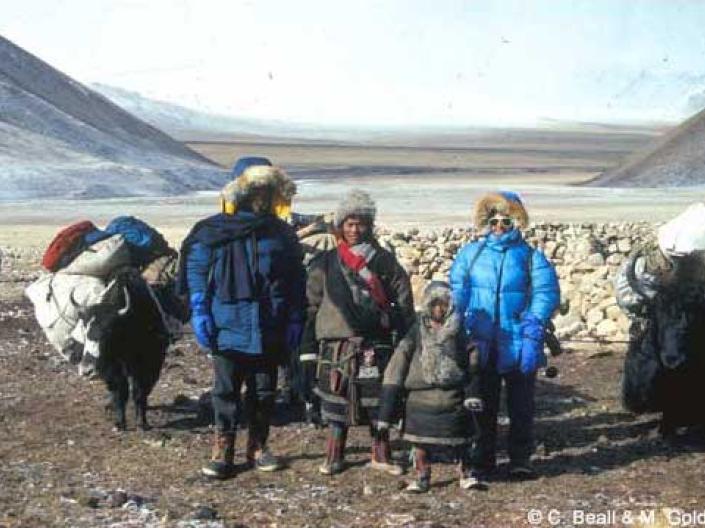
involved. Some of these, like those from Pala, travel three to four days to
reach the site. In 1987, word was transmitted to all nomad encampments by letter
and oral message about two weeks before the starting date. The nomads had been
anticipating this date and inunediately set about finalizing preparations for
the trip-how many and which yaks to take, and who to send with them. Some nomads
shared tents with friends or relatives, thus messages went back and forth
between households to arrange whose tent, whose tea churn, whose pots and pans
to bring and when to depart.
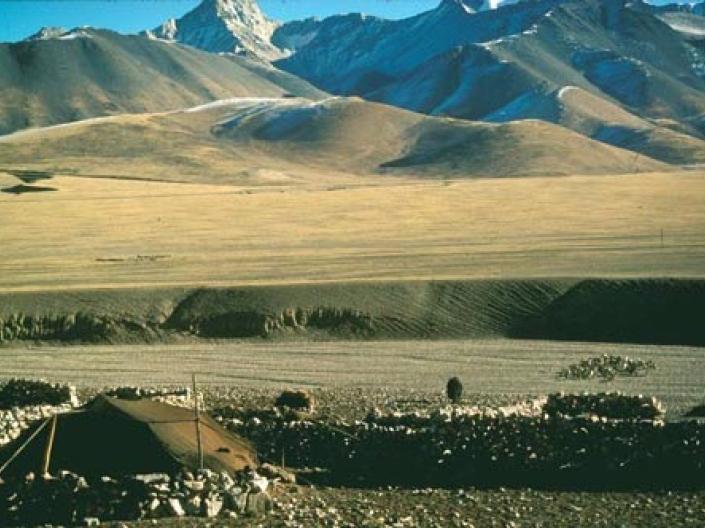
As soon as we arrived we understood why this was the "hay-cutting"
area, for unlike the rest of
Lagyab lhojang, it consisted primarily of
tall vegetation (about one to one-and-a-half feet) thick enough to be gathered
into a handful and cut with a sickle. We counted just over 100 tents and were
amazed at the activity there. In contrast to the few people and the slow pace of
life at a nomad encampment, the grass-cutting camp was bustling with
activity-some taking their horses and yak out to graze, others talking and
joking with friends they had not seen for a year or more. The bazaar-like
atmosphere was enhanced by a dozen or so traders, some nomads, and others,
villagers from weeks away. Even the government store opened a temporary branch.
They all
sat behind heaps of miscellaneous wares including everything from
prayer books and rosaries to wooden saddles and bowls, to pots and ladles and
plastic jerry cans to Chinese "boom boxes" used to play prayer chants
and traditional melodies typically on cassettes imported from Nepal.
At 8 a.m. on the specified day, an official blew a whistle to start the
cutting. Everyone rushed to the adjacent slopes and plains in search of the
perfect spot. People would cut for
an hour or so, stuffing handfuls of grass
into their cloaks, then pause to fashion them into two-foot-long twists and
carry bundles of these back to their tent to dry. Then they returned to start
all over again. In the evening, attention focused on the traders and their
wares, the nomads making the rounds of the 10 or more "stalls" set out
on blankets on the ground, exan*ting goods, asking prices, and bartering
energetically. Wlen darkness made business impossible, other activities began:
some younger nomads danced and sang, others played Tibetan dice or ma jong,
while most just sat around drinking tea and talking. The festive atmosphere was
contagious and we had a steady stream of nomads from other areas who wanted to
see and chat with the chigye (foreigners) who spoke Tibetan. Scores of
nomads now know that U.S. astronauts walked on the moon and that it is evening
in American when it is daytime on the Changtang. For us it was a wonderful
opportunity to talk with nomads from adjacent districts about their conditions.
The impact of hay cutting on the overall pastoral economy, however,
is slight since this area provides too little hay to accommodate livestock
during those times when snow prevents the animals from grazing, let alone for
general use as a food supplement in winter and spring. And although some is
occasionally
given to lactating sheep and goats, virtually all is used to
supplement the winter diet of the horses owned by the more affluent households.
And nowadays, each nomad household also has to provide a small hay allotment to
the district officials for their horses. Poor nomads go to cut grass to sell to
the richer households who want more hay than they can cut (or who were unable to
come at all that year). This is one of the ways that the poor supplement the
insufficient income from their small herds.
The flurry of activity is short-lived. As soon as a nomad household has cut
enough
hay to load their yak, they break camp and leave. Five clays after the
tent city materialized out of nothing, the plains again were empty-and stay
so until the following September when the cycle of nomadic pastoral life will
again bring 100 or more tents to this obscure spot on the Changtang.