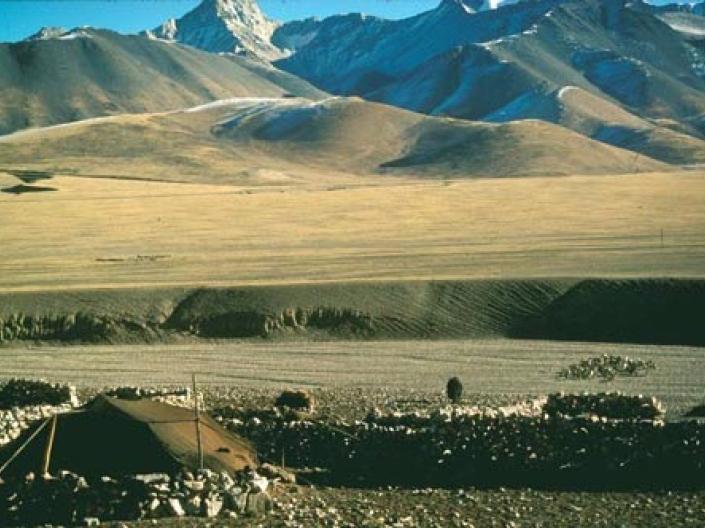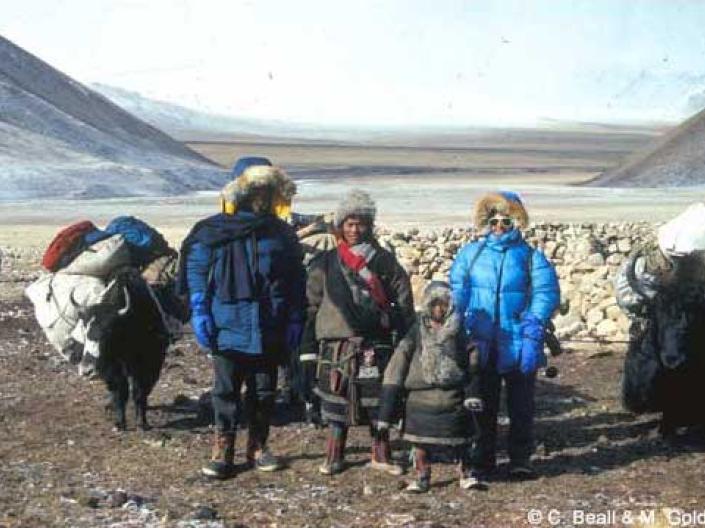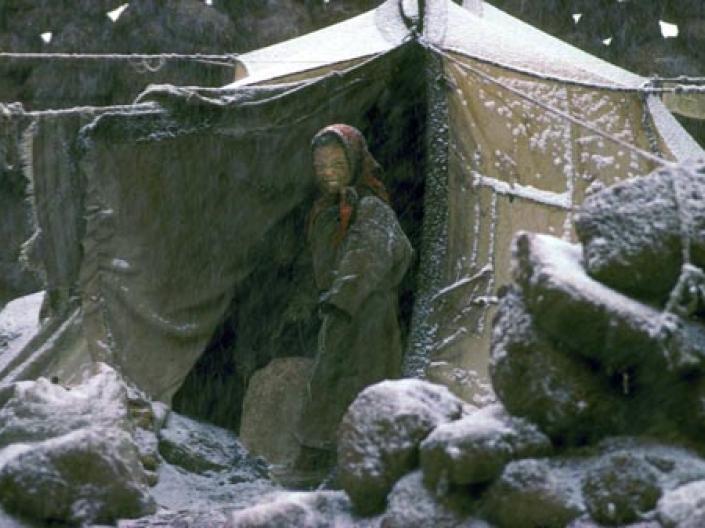
Fraternal Polyandry and Fertility in a High Himalayan Valley in Northwest Nepal Melvyn C. Goldstein (1) ----------------------------------------------------------------------------- The manner in which cultural factors affect fertility has become an important area of anthropological concern. In this article, it will be shown that while fraternal polyandry does not affect individual fertility it does have a significant depressing effect on aggregate fertility and functions, unperceived and unin- tended, as an important mechanism for reducing population growth. ----------------------------------------------------------------------------- KEY WORDS: fertility; polyandry; Nepal; Tibetans. Whereas early proponents of the demographic transition theory ignored cultural variables and contended that preindustrial societies existed in a kind of "natural" homeostasis in which natural (uncontrolled) fertility was balanced by high mortality, this is no longer accepted today. The importance of cultural factors in both the theoretical and applied areas of demography has become widely acknowledged and, within anthropology, a subdisciplinary focus is emerg- ing to deal with this under the rubric of population anthropology. In this ap- proach, the relationships between cultural and demographic variables are seen as complex, reciprocal, and often very subtle. This article deals with one such relationship by analyzing how fraternal polyandry affects fertility among a tradi- tional, preindustrial population in northwest Nepal. It also suggests, from a broader ecological perspective, how polyandry affects the overall adaptation of the population to its environment. Of all the forms of marriage and family, polyandry has remained among the least well understood in the anthropological literature. Polyandry is a form of marriage where two or more males share a bride, and fraternal polyandry is a variety of polyandry in which the two or males are siblings. Anthropoli- cal attemps at explaining this rather rare form of marriage and family have included factors such as female shortages, types of descent and inheritance, the maintenance of land holdings intact, and even psychoanalytic variables. How- ever, the very obvious and fundamental question of the effect of polyandry on fertility and overall adaptation has been ignored in this literature. Benedict (1972: 76), in a survey of social factors affecting fertility, sums up the scant data on polyandry as follows: Polyandry is so rare and the information about it so meager, that we can say very little about its effects on fertility. The Toda and the Jaunsari, the two polyan- drous societies listed by Nag, show no difference in the fertility levels of polyan- drous and nonpolyandrous married women. In my own previous research on polyandry (Goldstein, 1971), the question of "surplus" women was raised: if a significant proportion of the males are involved in polyandrous marriages, one would expect there to be a surplus of unmarried females bearring other neutralizing factors such as higher female mortality. Murdock (1949: 25) had earlier touched on the reverse of this issue in his classic study, Social Structure, when he commented that "despite the paucity of cases there seems reason to assume that polyandry may sometimes be due to a scarcity of women resulting from the practice of female infanticide." However, the nature of the data available to me previously precluded any satisfactory analysis of this issue, although there definitely was no pattern of female infan- ticide in Tibetan cultural areas. In 1974, I had the opportunity to undertake research on this and related aspects of polyandry as part of a larger study on monasticism carried out in the Tibetan-speaking Limi Valley in the northwest corner of Nepal; in this artlce, I will try to address these issues by analyzing the consequences of fraternal polyandry for fertility and overall adaptation in this valley. Limi is a high mountain valley, running northeast to southwest and con- taining three villages. All of these are over 12,000 ft in elevation; Tsand, the highest village and the one in which the most detailed work was done, is at 12,900 ft. While politically a part of Nepal, the people of Limi are linguistically and culturally Tibetan. They have an agropastoral type os subsistence economy which includes large-scale herding of sheep and yak in addition to agriculture. Trade and craft production are also important in their overall adaptation.(2) The three villages in Limi have a total population of 791. This population claims to be endogamous. Empirically less than 1% of the marriages have been with outsides (either Tibetans or Tibetan-speakers in the Humla Karnali ecozone south of Limi). The age-sex distribution of Tsang is presented in Fig.1. While 49.3% of the overall population in Tsand is female and 50.7% male, there are, in the reproductive age bracket (15-44), more females than males (76 to 68).Contrary to Murdock's suggestion, polyandry in Limi clearly is not the result of any shortage of women. Data on migration corroborate this. Limi is not affected by movements of population. There is virtually no outmigration. Cases of immigration are limited to several Tibetan nomad refugee males who married Limi girls after the political upheaval in Tibet in 1960-1961. As in most areas of Tibetan culture, the largest kinship unit in Limi is the corporate family. Marriages are usually patrilocal and either monogamous or polyandrous (fraternal). In Limi I have recorded fraternal polyandrous marriage with up to five brothers sharing a bridge, although normally the number is only two or three. Contrary to practices in Tibet, bigenerational polyandry and polygyny (father and son or mother and daughter sharing a spouse) are not permitted. Plural polyandry or polygynadry (two or more brothers sharing more than one wife) is, however, encountered. Also unlike standard Tibetan practice is the fact that bilateral cross-cousin marriage (marriage, for a male, to his mother's brother's daugher or father's sister's daughter) is esteemed in Limi, whereas in Tibet it is considered incestuous. Such cross-cousin marriage may be polyandrous or monogamous.
Polyandry is the normal form of marriage when a family has more than one son. In Tsang, 20 of the 52 marriages recorded were polyandrous. Of the 32 monogamous marriages, seven were in instances where a family had only one son, 23 were cases where brothers split off from previously consummated poly- androus marriages, and two were cases where brothers split up before marriage, each of them marrying monogamously. The 20 polyandrous mamages included 54 males (seven under 14 years), whereas the monogamous marriages included only 32 males. The 20 polyandrous marriages contained 23 females(3) thus yielding an average of 2.35 males per female. If we assume that without polyandry each of the 23 females would have had one husband, there are, then, 31 "excess" males who are absorbed by polyandry, i.e., who will not seek a separate bride. This is 21% of the total males in Tsang and 33% of the males from 10 to 54 years of age. Polyandry does not seem to have any significant effect on the fertility of individual females, although it is very difficult to control for mediating factors with respect to this question. A basic problem in ascertaining fertility levels in polyandrous vs. monogamous marriages is to establish whether there has been a switch in form (usually polyandrous to monogamous) in the developmental cycle of each family in the sample. In Limi there were two main sources of switching: (1) death of all but one husband in polyandrous marriage and (2) splitting off of all but one male in an initially polyandrous arrangement. A similar problem arises in cases where jurally polyandrous marriages are sexually monogamous because all but one of the males have not yet reached puberty. In some cases, such a situation may continue for even a decade. In the following analysis, I have tried to maximize the accuracy of the data by eliminating from the calculations all cases which included any of these ob- fuscating elements. Polyandrous marriages in which only one male was of re- productive age are assigned to the monogamous gategory. The Tsang data sum- marized in Table I show that the average number of living children Is 2.9 for
![]()
monogamously married women and 2.7 for polyandrously manied women.(4) These differences are not significant and accord with the previously cited data on the Toda and Jaunsari with respect to the absence of effect of polyandry on individual fertility. However, polyandry does have very important effects on fertility when viewed from a population point of view. Without the intervention of cultural or biological mechanisms to reduce the number of females, one would expect that a marriage system such as just described would generate a sizable number of "surplus" unmarried women. And in Limi there are no intervening mechanisms. There is no infanticide of any kind and no polygyny (one man having, by himself, two or more wives).(5) As men- tioned above, there were in fact more females than males (76 to 68) in the reproductive age bracket. Not surprisingly, we also found a significant surplus of unmarried women. In Tsang, 31% (or 21 out of 67) of the females of childbear- ing age but over 20 (20-49) were unmarried.(6) This figure would be even higher if we were to include 18- and l9-year-old females, but, since they still have a fair chance for marriage, they have been omitted. The proportion of unmarried females in each age category is indicated in Table II. These proportions are extremely high for a preindustrial traditional society. For example, in neighboring, nonpolyandrous India (data presented in Table III), we find that for the 20-24 year age bracket two of the three Bengali groups have no unmarried females and one has only 2% unmarried females. In these communities, there are no women over 25 who were not married at least once. In actuality, the proportion of unmarried females over 20 years of age in Limi is more like the proportions in European industrial countries. Davis and Blake (1956: 218), for example, state that the proportion of women past child- bearing age who were never married was 26.3% for Ireland (1946), 20.9% for Sweden (1945), 20.1% for Switzerland (1941), 16.8% for England and Wales (1931), and 13.3% for Belgium (1930). Unmarried females in Limi either (1) continue to live at home (eight cases), (2) establish their own separate households (seven cases), or (3) work as servants for others (three cases). There is mild social stigma for females who do not get married but there is no ostracism or social isolation. There is, moreover, a named social category (morang) for unmarried women having independent households, and these units have lower tax and corvee responsibilities than the other polyandrous and monogamous family units. Not being married, however is not synonymous with exclusion from the reproductive pool. Extramarital relationships, if discreet, are tolerated and there- fore a number of the so-called unmarried women do in fact have offspring. Actually, half of the women in this category had one or more children. However, it is critical to note here that the rate of offspring per "unmarried" female is far lower than that of married women. The average number of living children in 1974 for married women was 3.3 per woman, whereas the average for the unmarried women aged 20+ was 0.7 per woman (see Table II). As there is no infanticide and no significant difference in diet or style of life, the explanation of this difference is assumed here to be frequency of coitus, although data are not readily available. Aside from factors such as the need for discreetness and the difficulty of privacy, there are several important economic motives which seem to restrain frequency of coitus. From the male's point of view, illegitimate children are expensive. The genitor is jurally responsible for his children, illegitimate or not, and is required to provide a variety of items such as a yak, clothes, a sword, and often even some plots of land. There is a great deal of open discussion among males (particularly the younger ones) about the risks of having affairs with unmarried women and this must certainly act as a restraint on the cautious and the poor. From the woman's point of view, children are also difficult to support. The payments made by the genitor are insufficient to sustain a child and unmar- ried females do not have enough land even to support themselves, let alone their children. They make up their deficits partly by weaving cloth and selling it but mainly by working for others. There is, therefore, a limit to the amount of deficit a woman can overcome, since she can only weave so fast and work so many days. My contention is that after the second child, and perhaps even after the first, the economic pressures become so great that unless there is some unusual source of income available, unmarried females voluntarily either assume a celibate role or have intercourse at most on infrequent occasions. One well-to- do man In Tsang has an open relationship with his unmarried neighbor. He supports her and openly treats her children much like his own. He is able to dispense with normal discreetness because his wife many years ago had an illegitimate child and thus, quite literally, forfeited her right to object to his
actions. It is significant to note that in this case the unmarried woman (who is 40 years of age) has four living children. This is above the average for mairied women and the only example of an unmarried woman with more than two children. In any case, regardless of the cause of this significantly lower rate of children for the unmarried woman, its consequences are obvious for the overall population picture. Polyandry effectively restricts 31% of the reproductive-age females over 20 from full participation in childbearing. If this 31% were married and averaged the same 3.3 living offspring per female as married Tsang women do, the differ- ence between this and the 0.7 rate for unmarried women would mean an in- crease of 47 persons or an increase of 16% of the total village population. Over a period of several generations (see Fig. 2), the significance of this for population growth is impressive. If half of the 47 "extra" people were females and if they averaged 3.3 offspring, then the next generation would have an increase of 78 persons and the following generation an increase of 129 (based solely on the projected offspring of the "unmarried" females). Given the fact that the present population of Tsang is only 288, it is easy to see how substantial these increases would be. Although, previously unmentioned in the anthropological literature on marriage and the family, fraternal polyandry (of the Tibetan type) clearly oper- ates to depress population growth by producing a residue of females who are only marginally involved in reproduction. However, the adaptive significance of poly- andry goes beyond this. My further contention is that fraternal polyandry in Limi is part of a negative feedback process which operates to adjust, to a degree at least, population size to resources. As an introduction to discussion of the nature of this feedback loop, brief comments are necessary on the reasons that the villagers themselves have for the practice of polyandry. The reader should be forewarned, however, that this is a very comphcated subject which can only be dealt with here selectively. Individuals in Limi certainly do not embark on polyandrous marriages to reduce individual or aggregate fertility levels. No amount of questioning indi- cated that any of the subjects saw any connection between polyandry and fertility, and the fact that scholars have also not seen this connection is corroba- rating evidence for the elusiveness of this relationship. The inhabitants of Limi also do not marry polyandrously because they enjoy sharing a wife with other siblings or because of any deeply rooted motivational value such as "sibling solidarity." As we shall see, a variety of interpersonal tensions and conflicts are not uncommon in polyandrous alliances. The subjects' own explanation of their preference for polyandry is highly materialistic. They choose fraternal polyandry to preserve the productive re- sources of their family units (primarily land and secondarily animals) across generations. Polyandry is perceived and consciously selected as a means of precluding the division of a family's resources among its male heirs. Since land is scarce and most families have less than 1 acre of arable land, the people of Limi consider the maintenance of this land intact, i.e., without being split into smaller and smaller parcels, a critical factor in sustaining a satisfactory standard of living. Fraternal polyandry is the mechanism they use to accomplish this. Polyandry achieves this goal by providing an intrafamilial milieu in which discord is minimized by the presence of only one wife on each generational level and thus only one set of heirs. It avoids the development of a situation in which nuclear family units within the famly consisting of a brother, his wife, and children compete with each other. The fact that there is only one wife and one set of children (heirs) is believed to be a major deterrent to serious conflict and fusion. Whether this belief is correct is a question beyond the scope of this article. Suffice it to reiterate here that this is clearly the primary motivating factor for polyandry in Limi (and Tibet).(7) But polyandry is not without problems. Because authority (among brothers) is customarily exercised by the eldest brother, younger male siblings have to subordinate themselves with little hope of ever changing their status. When these younger brothers are aggressive and individualistic, intrasibling ten- sions and difficulties often occur. Another, very common source of tension in polyandrous families is asymmetry in relations between the wife and her husbands. While the cultural ideal in Limi is for symmetrical treatment in terms of affection and sexual access, deviations from this ideal occur and generate intrafamilial tensions, if not outright conflict. Such "deviations" are particularly common when there is a sizable age difference between the partners in the marriage. It is not uncommon for gaps of 10 years to exist between brothers and, since marriages are initiated when the eldest brother is ready for marriage, there are also often sizable gaps in age between the wife and the youngest brother. Thus a brother who is 10 when a polyandious marriage takes place would find that when he is 20 his wife is almost 30, a situation which might be perceived by him as unsatisfactory and which might therefore result in a poor relationship with the wife in terms of either companionship or sex. Obviously, there can be all kinds of variations on this and it suffices here simply to em- phasize that while polyandry provides an answer to one type of culturally per- ceived problem (albeit one which the subjects see as critical) it does generate other types of problems. In a sense, therefore, polyandry is seen as the lesser of two evils. Degrees of individual freedom are traded off for degrees of economic security. Polyandry flourishes when younger brothers feel they cannot attain a satisfactory standard of living if they split off from their family and go it alone. When resources and economic opportunities are abundant, however, it is common for younger brothers to split off and establish new (neolocal and monogamous) family units. The feedback nature of this situation is obvious. An abundance of economic opportunities leads to less complete(8) polyandry and more monogamous family units. These in turn produce an increase in population by bringing otherwise unmarried females fully into the reproductive cycle. Finally, unless there is con- tinual expansion of the economic sphere, the increasing population exerts greater and greater pressure on resources and this leads to a greater adherence to fraternal polyandry. Unperceived by the subjects, then, polyandry functions as a sensitive cultural mechanism for adjusting population levels to changes in re- source availability and economic productivity. In summary, this article has tried to expand our growing awareness of the manner in which cultural institutions act to keep fertility levels lower than the biological potential of populations. It has done this by showing briefly the effects of polyandry on fertility in one Himalayan population. The article has illustrated how polyandry, while not affecting individual fertility of those who are married, does significantly affect fertility rates by generating a surplus of unmarried females. The article also shows how this consequence is unintended and unper- ceived by the subjects, who opt for fraternal polyandry rather than monogamy for economic reasons. Finally, it is hypothesized that from a diachronic per- spective polyandry in Limi is part of a negative feedback system which func- tions to adjust population to changes in resource availability. Notes (1)Department of Anthropology, Case Western Reserve University, Cleveland Ohio. (2)For a general overview of the adaptation of the population of Limi, see Goldstein (1974, 1975). (3)The discrepancy between polyandrous marriages and 23 females is explained by the pres- ence of three marriages which consist of two or more brothers and two wives. This is polygynandry, as previously mentioned, and is here included under the larger category "fraternal polyandry." (4)These averages are somewhat lower than the total average in Tsang, 3.3 because a number of dubious cases (with respect to polyandry vs. monogamy) have been excluded. (5)But there is no cultural prohibition with respect to polygyny. (6)There is no simple pattern concerning which females in each generation get married and which do not, and it is clearly not the case that female children of "unmarried" females have a more difficult time finding husbands. In fact, if there is any "class" factor operative, it is associated not with the poor but with the heredity high-status families. Upper-strata marriages require a considerable dowry, whereas poor families without high ascribed status require virtually nothing. Consequently, it is often financiallly difficult for poor but high-status families to marry off daughters, particulary if there is more than one. More important that this factor is the reputation of a female for diligence and hard work, and her personal- ity. Social status is at best a secondary factor. (7)Maintenance of an optimum adult labor force is a secondary, although signigicant, motivat- ing factor with respect to polyandry. For a more elaborate examination of polyandry in traditional Tibetan society, see Goldstein (1971). (8)The splitting off of one brother does not necessarily end in monogamy when there are three or more brothers, since usually the others remain in the polyandrous alliance. Acknowledgments I wish to thank Case Western Reserve University for supporting this research by granting me an early sabbatical. I also wish to thank Dean P. R. Sharma and Professor A. W. MacDonald of the Nepal and Asian Studies Institute of Tribhuvan University, Kathmandu, Nepal, and Dr. Harka B. Gurung of the Nepalese National Planning Commission for their advice and assistance, and H. M. G. of Nepal for generously giving me permission to undertake research in Limi. I would, finally, like to express my gratitude to the various colleagues who have read drafts of this article and offered helpful comments. References Benedict, B. (1972). Social regulation of fertility. In Hamson, G. A., and Boyce, A. J. (eds.), The Structure of Human Populations, Clarendon Press, Oxford, London. Davis, K., and Blake, J. (1956). Social structure and fertility: An analytic framework. Economic Development and Cultural Change 4: 211-235. Goldstein, M. C. (1971). Stratificatlon, polyandry, and family structure in Central Tibet. Southwestern Journal of Anthropology 27(1): 64-74. Goldstein, M. C. (1974). Tibetan speaking agro-pastoralists of Limi: A cultural ecological overview of high altitude adaptation in the Northwest Himalaya. Objets et Mondes 14(4): 259-268. Goldstein, M. C. (1975). Report on Limi Panchayat, Humla District, Karnali Zone. Contri- butions to Nepalese Studies 2(2): 89-101, Muldock. G. (1949). Social Stnicture. Macmillan, New York. Nag, M. (1962). Factors Affecting Human Fertility in Non-industrial Societies: A Cross- Cultural Study. Yale University Publications in Anthropology, No. 66, Yale Universi- ty Press, New Haven.