Change and Continuity in Nomadic
Pastoralism on
the Western Tibetan plateau
Melvyn C Goldstein and Cynthia M Beall
Nomadic
pastoralism on the Tibet changtang flourishes. This paper gives an
overview of the situation of Tibet’s nomadic pastoralists and pays particular
attention to ecology and traditional subsistence economy. Severe environmental
conditions preclude farming. Livestock products earn substantial portions of
the Tibetan foreign exchange. These are factors encouraging nomadic
pastoralism. The impact of direct Chinese control in 1959 is also dealt with.
Pastureland is not being expropriated from the pastoralists. In spite of ill
thought-out development projects there has been no inducement for nomads to
resettle. A net effect of the Chinese "reform" policies has been
revitalization with increased economic independence since 1981 in spite of
potential problems.
Pastoralism has been reported to be in
danger of disappearing as a way of life in most of the world. This
"pastoral crisis":
derives from the simultaneous increase of
pressures to absorb pastoralists into the nonpastoral economy (through
settlement programs, wage policies favouring migrant labour, forced
commercialization, a relative drop of the value of pastoral products, and the
like) and of measures that directly deprive pastoralists of their former share
of economic and political life by the expansion of agriculture, military
patrols, destocking programs, and the destruction of traditional systems of
land tenure). The result of these powerful forces is that pastoralism is
increasingly being relegated to people too old to change, too poor in
alternative skills to leave, or too far away from centers of power for anyone
to care yet. (Galaty et. al. (eds) 1981:17).
This pessimistic description does not fit
conditions in the Tibet Autonomous Region (TAR) I of the People's Republic of
China, an area about which little is known because research there has not been
possible until recently. With 69% of its area pastureland and 24% (500,000) of
its population nomadic pastoralists, it is one of the world's major pastoral
regions. This paper presents an overview of the situation of Tibet's nomadic
pastoralists by describing salient features of their ecology and traditional
subsistence economy as well as their experience after the Chinese took direct
control of Tibet in 1959.
The data derive from anthropological field
research conducted in 1986, 1987, 1988 and 19902- A total of 20 months were
spent in the TAR, 14 with the nomads, including observations during all four
seasons. The research was carried out in conjunction with the Tibet Academy of
Social Sciences, and was supported by grants from the National Academy of
Sciences' Committee on Scholarly Communication with the People's Republic of
China (Program for Advanced Research and Study in China), the Committee on
Research and Exploration of the National Geographic Society, and the National
Science Foundation (BNS 87-04213). Standard social and physical anthropological
methods were used including participant observation, key informant interviewing
and systematic measurement of biological parameters. No restrictions on our
movement within the research area or on interviewing were encountered.
Ecological data were also collected in collaboration with Dr. Richard Cincotta,
a rangeland ecologist who joined us in the field in the summer of 1987.
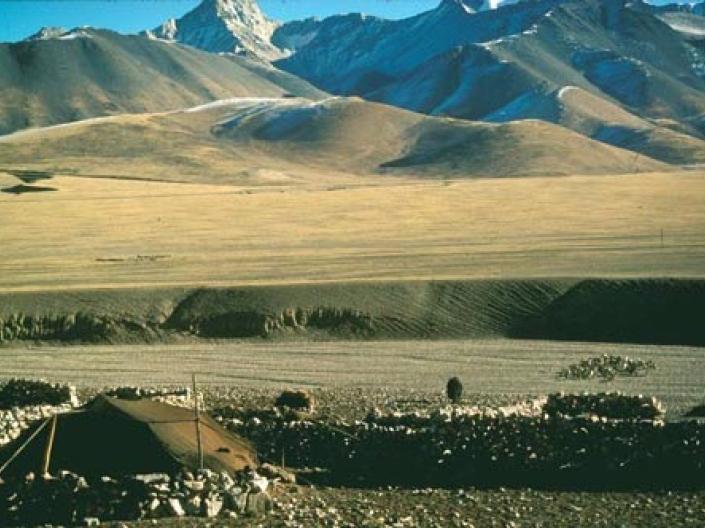
The study was conducted in a remote,
traditional nomad area called Phala. Located on the changtang
("northern plateau") 3 about 300 miles northwest of Lhasa and 115 miles
north of the TAR's main east-west road (see map 1), these pastoralists raise
sheep, goats, yak4 and horses and do not engage in any
farming.

Indeed, the nearest farming communities
are roughly 20-30 days' walk to the southeast; and areas to the west, south,
northeast and north contain only nomadic pastoralists. With their main camps
situated at altitudes between 16,000-17,800', the nomadic pastoralists of Phala
are the highest dwelling traditional native population in the world. Such
altitudes, moreover, are typical of the western changtang.
The Changtang Environment
A key to the stability and success of
nomadic pastoralism in Tibet is the character of the changtang, the
montane plateau that is home to the majority of its nomads. This changtang
corresponds roughly to the Northern Tibet Plateau sub-area of the Qinghai-Tibet
plateau as it is defined by Chinese scientists. The Northern Tibet Plateau
includes most of the central-northern part of Tibet and western Qinghai, and is
bounded in the north by the Kunlun mountains and by the Gandise range in the
south (see map 1). Within this, the Ngari Plateau Subregion corresponds to the
area of our research in the western Tibetan changtang. It is the highest
and coldest part of the Qinghai-Tibet plateau with ground altitudes ranging
from about 15,000-18,000'. Annual precipitation is generally between 60-300 mm
with aridity becoming more severe as one goes west. The Chinese classify its
soil as mainly alpine desert soil and the vegetation as mainly steppe type with
ground cover of less than 30% (Ren mei'e, Yang and Bao 1985:417, 450-451; China
Handbook Editorial Committee 1983:44).5
Situated
in the eastern part of the Ngari Plateau Subregion, Phala contains 57 tentholds
and 265 persons dispersed among 10 camps in an approximately 250 square mile
area. Reference to the area as a plateau, however, is somewhat misleading since
rather than being flat, it actually consists of many small mountain chains
interspersed between high altitude valleys and plains. In Phala, for example,
several mountain passes of 17,500' or higher must be crossed in order to reach
all 10 of its main campsites.6
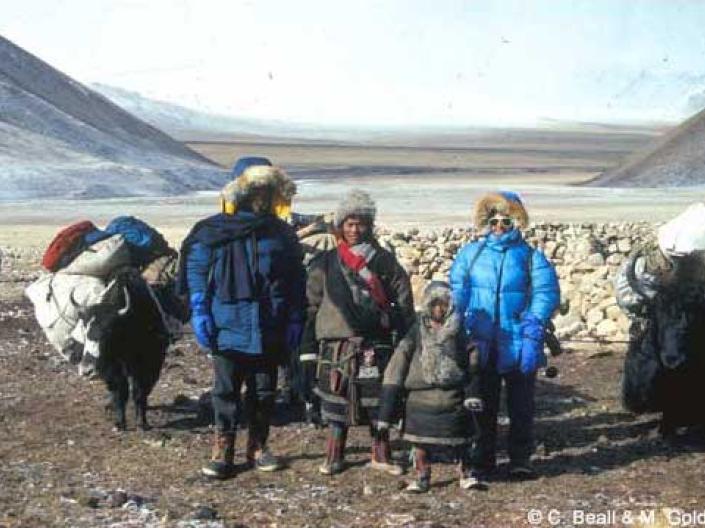
Phala experiences one of the most severe
climates in the world. Winter lows range from minus 20-50 degrees F, and
mid-summer lows hover around freezing. Winds are fierce and intermittent
throughout the year. Precipitation is monsoonal, falling mostly during June,
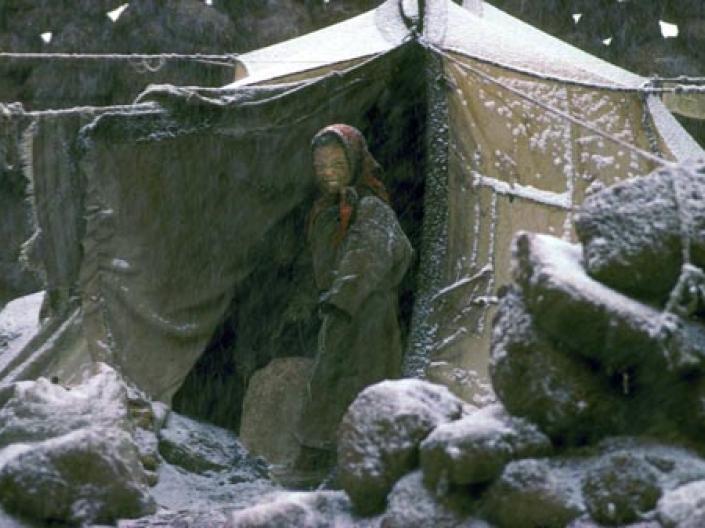
July and August (often in the form of snow and hail storms). There is very
little snow in winter, although late fall and spring snow storms occur and are
greatly feared. Weather, moreover, is extremely localized with adjacent areas
often experiencing different amounts of rainfall or snow in any given year. The
changtang’s single growing season begins in late April-early May and
ceases in September.7 But even during this period, snow, hail storms
and evening frosts are common. Since no pasture areas in Tibet have a winter
growing season (and because there is inadequate grass to cut as fodder to
supplement winter grazing8), the nomads' animals subsist for about 8
months on the senescent vegetation remaining at the end of the growing season.
These factors- the short growing season, the intense cold, and the frequent and
fierce summer hail storms and frosts-combine to make farming an unviable
alternative to pastoralism and to preclude competition from farmers for an
alternative use of the grasslands. The nomadic pastoralists in Phala and the
surrounding areas, therefore are exploiting precisely the same territory as
they did during the traditional era. In fact, if there were no nomadic
pastoralists, the changtang would revert to the wild animals with whom
the nomads share the area, not to humans utilizing another subsistence
technology.
The Phala Nomads In the Traditional Era
Traditional Tibetan society ended in 1959
when the Dalai Lama fled into exile in India and the Chinese government assumed
direct control of Tibet. Before that, for at least several hundred years, the
nomadic pastoralists of Phala and the other parts of northern and
western Tibet were directly integrated into the semi-feudal "tribute"
system that characterized the traditional Tibetan state. Land and people in
Tibet were organized not as tribes but rather as manorial nomadic
estates (fiefs) controlled by religious and aristocratic lords, or by the
government itself.
The Phala pastoralists were
one of 10 named nomad groups (tso) comprising Lagyab lhojang, a
vast nomad estate that belonged to the Panchen Lama, Tibet's second greatest
incarnate lama whose base was located in Shigatse, several hundred miles to the
southeast. Like peasants (serfs) on
agricultural estates, these nomads were hereditarily tied to their estate and
did not have the right to take their herds and move to an estate of another
lord, although each pastoral household owned and managed its own animals' The
Phala nomads' economic obligation to their lord consisted mainly of providing
butter for the tea and votive lamps of Tashilhunpo, the Panchen Lama's huge
monastery in Shigatse, but also included providing items such as skins, ropes,
wool, animals and salt. Goods left after paying taxes and fulfilling work
obligations belonged to the nomad household and were consumed or disposed of as
that household chose.10
The most important aspects of the Panchen Lama's administration of this nomad area (estate) included allocation and reallocation of pasture, appointment of local nomads as leaders, collection of taxes, and adjudication of disputes.
The entire area of Lagyab
Lhojang was divided into named pastures of varying sizes, often small,
each with delimited borders that were recorded in a locally maintained register
book. Although there were no fences around these pastures, boundaries were
enforced by art the lord, and without explicit permission, nomads could only
use the pastures he allocated to them, even if their own pastures experienced
untimely drought or snow.
Each named pasture was
considered suitable to support a fixed number of animals, the lord in Phala
calculating this by means of a unit termed “marke.” In the 1950’s, one marke
of pasture was equal to 13 yak, and since 7 goats or 6 sheep were calculated as
equivalent to one yak, 78 sheep or 91 goals also equaled 1 marke.
The Panchen Lama's officials
conducted a triennial household census of all adult animals excluding horses
and stud animals to determine the distribution of animals in Lagyab. They
allocated pastureland to households on the basis of this, each household having
complete usufruct rights over their allocation of pasture until the next
census. Taxes were calculated in accordance with a fixed schedule linked to the
number of marke. Whether a family's herds increased or decreased during
that 3 year interval, the tax obligation remained the same. However, when the next
census was taken 3 years later, households whose herds had increased were
allocated additional pastures and those whose herds had decreased lost one or
more pastures. Taxes were also adjusted at this time. Households normally
received multiple pastures appropriate for use in different seasons.
Animals during the
traditional period, therefore, were privately owned by the nomadic pastoralists
but all pastureland in Phala and Lagyab Lhojang was owned by a lord who was not
part of the nomad community. Both the nomads and the lord were bound to a
relationship marked by delimited rights and obligations. The nomads were
hereditarily bound to their estate and legally could not unilaterally take
their animals and leave, but neither could the lord unilaterally replace them
with other nomads.
Since
there was no fresh vegetation anywhere in Western and Central Tibet from mid
September to May, there was no advantage to driving one's herds hundreds of
miles to new pastures. So long as the pastures nearby were sufficient for one's
livestock, long distance migrations would serve only to weaken the animals, not
improve them. Thus, the pasture areas that any nomadic pastoralist household
could utilize were generally nearby. In Phala, for example, the nomads'
furthest move for pasture was only about 25-30 miles, and most households moved
less than this. Long distance travel, however, occurred for activities such as
trade and the collection of salt from distant salt flats.
Socio-economic stratification within nomadic pastoral society was also a salient feature of the traditional era. Although all the Phala nomads belonging to the Panchen Lama had rights to pasture land, many nomads had no (or very few) livestock and subsisted by working as servants or workers for wealthy households. This stratification system tended to be hereditary.
Phala's nomadic pastoralists,
therefore, were organized into estates within a well developed and stable
state, structurally the same as Tibet's agricultural peasants.
Without delving into the complex history of
Sino-Tibetan relations in the 20th century, it will suffice to indicate that
after an eight year uneasy relationship between the traditional Tibetan
government and the Chinese officials who entered Tibet in 1951 as a result of
the Seventeen Point Agreement'1 relations completely broke down in March of
1959 when many Tibetans revolted and the Dalai Lama fled into exile. From that
point on, the Phala nomads came under the direct administration of the People's
Republic of China.
Although extreme measures
were used to suppress the revolt in Lhasa and implement communist reforms in
Lhasa and the surrounding areas, at first, little changed in Phala with regard
to hording and subsistence. Monasteries were dosed, monks senthome,12
and new local officials were appointed by the government, and the three year
animal census scheduled for l959 never occurred. Everyone, therefore, kept the
pastures they then held, managing their herds as they had in the past. In 1960,
one of the former nomad leaders who had actively supported the Dalai Lama was
arrested and committed suicide—his property and animals being redistributed
among poor nomads.13 Debts dating from before 1958 were rescinded
and those contracted in 1959 were recalculated with contracted in 1959 were
recalculated with reduced interest. A new nomad "class" structure was
begun, but households classified as "wealthy" (drongda) were
not expropriated so the economic situation of the poor did not change much at
first under communist rule.
In early 1961, the relatively
benign policy called
“mutual aid” (rogre) was implemented in Phala. In this system (as it
operated in nomad country) several households from the ''middle" and
"poor" classes were formed into mutual aid groups that cooperated in
tasks such as herding. Each small "mutual aid group" was given
exclusive usufruct rights over specific pastures based on the size of their
herds. But no provision for reallocating pasture with respect to changes in
herd size was made. Changes were now made on an ad hoc basis by local
officials.
During this
period, economic decisions remained located at the household level, and income
was not pooled by members of each "mutual aid" group,—each household
in it received the income from its own herd.
This era also brought the
first serious persecution of the members of the former nomad
"wealthy" class. These people had already lost all their authority
and status. Now they were not permitted to "join" the mutual aid
system and were forced to pay higher taxes. Significantly, however, they were
still allowed to operate independently— their animals were not confiscated and
they were permitted to continue hiring other poor nomads as servants and
shepherds, albeit at higher wages than what other nomads paid. They also could
still sell their products as they wished after they fulfilled tax and other
state obligations. Discussions with nomads in two areas adjacent to Phala
suggest that this system was implemented similarly throughout the western changtang.
Thus, the household system of pastoral production did not end when the Chinese
Communists took direct control over Tibet.
The emergence of the
"Great Proletarian Cultural Revolution" in eastern China in late 1966
eventually introduced a new phase of more radical political intrusions into
daily life in
urban and village Tibet, and finally the changtang. Political "struggle sessions" and active
class conflict was begun in Phala. In early 1969,afterword arrived that the
nomad areas were going to be reconstituted into communes later that year, the
overwhelming majority of the Phala nomads, led by their traditional leaders,
rose up in rebellion and took physical control of their area, killing several
(pro-communist) Tibetan officials in the process. They set up a government of
sorts and declared religious and economic freedom as the basic tenets of their
administration. Armed only with matchlock rifles and swords, they were quickly
subdued by the Chinese army that marched in from bases to the south led by the
remaining pro-communist Tibetan officials. After the arrest and execution of
some leaders and imprisonment and "reeducation" of others, full
fledged nomad communes and revolutionary committees were instituted. At this
time the animals and property of the "wealthy" classes were
confiscated. Overnight, Phala became two communal brigades. The nomads became
"owners" of shares of the commune, but in reality were simply
laborers who worked in accordance with the commune leaders' orders. The
pastoral technology remained basically the same, but social and political
organization were dramatically transformed, and both the ownership of the means
of production and all marketing and production decisions were shifted from the
household to the commune. As in agricultural communes in the rest of China, the
nomads received "work points" for the work they did, earning food and
goods on the basis of the "work points" accumulated throughout the
year. The situation in Phala remained communal until late 1981.
During the commune period
(1969-1981), there was no attempt to diminish the geographic scope of
pastoralism by expropriating nomad pastureland or resettling nomads in
agricultural areas. Nor was there any attempt to settle Tibetan or Chinese
(Han) farmers in the nomad areas as occurred in other areas such as Inner
Mongolia. Several programs to increase yields by irrigating and fencing
pastures were trial in Phala, and an agricultural test plot was also set up in
one small area, but these all failed. Thus, these changes did not alter the
basic relationship of the livestock and pastureland.
Trade continued to be
critical to the local subsistence economy, and pastoral products such as live
animals and excess wool were transported by the commune's carrying animals to village
areas 20-30 days to the southeast and there bartered for grain with farming
communes and government offices. Here again, there was no fundamental change in
trading patterns except that now it was communes trading with communes and
government offices rather than individual families trading with each other In
particular, there was no attempt to specialize production in wool or meat and
thus alter the general composition of the area's herds.
While full-scale pastoralism
continued during the Cultural Revolution, expression of much of the
pastoralists' traditional culture was prohibited. The policy known as "destroying the 4 olds"4
was energetically implemented with the aim of destroying the traditional
culture and creating a new atheistic communist culture. Religion activities
were totally forbidden, religious structures including monasteries and
prayer-walls15 were destroyed, and the nomads were forced to cut
their braids and even abandon deeply held traditional values such as the taboo
against women slaughtering animals. This was a difficult period since food was
inadequate and their values and norms deliberately turned topsy turvy. Chinese
policy during this period, therefore, sought to maintain pastoral production
but destroy the social and cultural fabric of the nomads' traditional way of
life.
The death of Mao Zedong in 1976 and the
destruction of the "Gang of Four" shortly after that, ushered in a
new era in China. Headed
by Deng Xiaoping, the new leaders opted for liberalizing China's economy by
ending communes and returning to a household based system of production in
rural areas. In Tibet, these reforms are known as the system of "complete
responsibility" (gendzang). It began in Phala in the Fall of 1981
when the commune was dissolved and all the commune's animals were divided
equally among the nomads—infants and senior citizen nomads receiving the same
share.16 Overnight, each household, was again, as in the pre-1959
era, responsible for its own production and marketing.
Each nomad in 1981 received
as an equal share of the commune's livestock: 39 animals (4.5 yak, 27 sheep and
7.5 goats).17 In additional to this, households were allowed to
retain the "private" animals they had held during the commune era.18
This raised the average to 42.4 animals per person (4.7 yak, 27 sheep and 10.7
goats).19 This number of animals, in conjunction with another
post-1980 reform exempting all nomads and farmers in Tibet from taxes until at
least 1990, was adequate for a decent, but lower middle-class subsistence. In
other words, bare subsistence was no problem, but surpluses from this number of
animals would generally not be sufficient to permit purchase of luxury goods
such as horses and jewelry.
Phala, administratively, was
now called a xiang, the traditional Chinese term for township. This xiang is divided into two
administrative units (drogtso) corresponding exactly to Phala's two
"brigades" during the commune era. These, in turn, were sub-divided
into 10 dzug each containing 2 to 9 households, and each having
exclusive usufruct rights over pastures. Families can change dzug only
with the permission of the members of the receiving drug and the local xiang
government. The latter functions primarily to collect local data, implement decisions
handed down from above, and is the initial legal-judicial body that deals with divorces, disputes and so
forth. Phala xiang is headed by two local nomads elected by secret ballot from a list of
candidates compiled by the level of government immediately above the xiang,
the qu.
The qu, or district,
is located on the changtang about three days' walk south of Phala. Its
officials are all Tibetans and it functions as the intermediary with the more
distant county government (xian or dzong) located at Ngamring
about 20 days' walk to the southeast of the Phala (but one day by car). Above
the xian is the prefecture of Shigatse, and above it the government of
the TAR.20 The language used in administration at the district and xiang
levels is Tibetan, and the district school teaches only Tibetan.
Phala's 57 households in 1988
averaged 4.7 members. 67% of the households contained an adult (a married
couple, a widow/widower, a divorcee, or a single mother) together with either
childless offspring or sometimes other unmarried siblings or friends. Another
16% consist of unmarried or divorced adults living alone, while only 9%
of the households consist of three generational families.
There is no policy of
population limitation on the changtang and the nomads have relatively
large families. Table I presents the average number of births and offspring
deaths to all Phala females age 20-59 regardless of marital status. It reveals
that women in each age category from 30 upward produce more than the two
surviving children necessary to replace the two parents. Women 40-49, for
example, experienced on the average 5.4 births, with 4.9 surviving.
Despite the excess of births
over deaths, Phala
has not experienced rapid population growth. Over the 7 years from 1981-88, the population
grew by only 2.7%, this a miniscule 0.4% annual growth rate (implying a 175
year doubling time). The reason for this net population stability is primarily
out-migration to contiguous nomadic pastoral groups, these shifts being for
non-economic reasons such as marriage or moving closer to relatives. The high
number of surviving offspring however, represents a latent potential for
growth, and Phala in the near future could experience much higher rates of
growth and increased population density.21
Table 1. Births and Offspring Mortality
Experienced by Phala women as of 1988
|
|
Culture and Religion Under the New Policy
The post-1980 Tibet policy of the Chinese
government parallels that implemented throughout other parts of China. It
rejects the earlier Maoist "assimilation" ideology for national
minorities, substituting in its place a policy that accepts the validity of
traditional minority culture and religion within the communist state. It also
eliminates the use of class distinctions and class struggle. An incident that
occurred during our fieldwork in Phala illustrates the extent to which the
latter has been implemented. A former ''poor" class (Upung) nomad
who had been an official during the commune period sold a sheep to a trader
before milking it, therein breaking a traditional nomad taboo. Nomads believe
that this could affect negatively the milk production of the entire camp, and
another man in the same camp, a former "class enemy" who had been
persecuted throughout the Cultural Revolution period, became incensed. He
started berating the seller and words soon changed to pushing and fighting.
They took the case before the xiang officials, the "poor"
class nomad arguing that the "wealthy" class nomad was looking down
on him because of his class background and was trying to impose old
superstitions on him. The local and district level officials were not impressed
with his anachronistic perspective and did not side with him, but instead fined
both men. It is noteworthy that one of those deciding this case, the senior
(elected) xiang leader, is a very well-liked former monk of
"wealthy" class background. A great deal has changed in Phala since
decollectivization.
This is nowhere more evident than with regard
to the practice of religion. During the period of our fieldwork in Phala the
nomads were free to practice their religion as they saw fit, and religion had
again become an important part of their lives. Each nomad home-base camp has
hired villagers to rebuild its prayer wall or walls, and nomads are again
pursuing the cycle of religious rites that typified the traditional society.
Most households have small altars in their tents and prayer flags fly from
their tent poles and guylines. Nomads make pilgrimages to monasteries and holy
sites and travel to visit Lamas without asking anyone's permission. Some are also actively
supporting the reemergence of monasticism by donating animals and food to help
rebuild small local monasteries, and by hiring monks to conduct prayers for
them.22 In summer, wandering monks and villagers come to the changtang
to do prayers, carve prayer stones, build walls and mold day figurines of
deities. Nomad practitioners of traditional Tibetan medicine are also active in
the area.
These traditional practices
did not reappear all at once or in an orderly fashion. The nomads at first
actually feared that the new policy was a devious trick launched to expose
pockets of "rightist" thinking, and were reluctant to take the lead
and risk being singled out. Change, therefore, occurred only gradually as
individual nomads took single actions that in effect tested the general policy.
When no protest or punishment came from the district officials above them, the
practice in question spread rapidly.
Phala's pastures have the same names and
roughly the same formally delimited boundaries as in the old society, but, as
in the "mutual aid" period, are allocated to small groups of
household—now to each of the 10 dzug’s. The households that comprise
these dzug have exclusive usufruct rights to these. However, there is no
system of pasture reallocation that adjusts pasture to increases or decreases
in the number of animals. Consequently, if dzug B's animals decrease by
50%, their allocation is not reduced even if it has unused pastures needed by a neighboring dzug whose
herd size has doubled. This represents one of the most serious deficiencies of
Tibet's post-commune pastoral policy.
This, moreover, is not just a
hypothetical issue—it has become a real problem. By 1989 several dzug
were experiencing serious shortages of pasture and were looking for more
pasture from other surrounding groups who are perceived to have excess pasture.
There are, however, no clear set of regulations regarding what is legal
regarding pastureland, and this has created confusion and frustration. One dzug
we know of, for example, allowed a group living in another district in
Nagchuka Prefecture to rent some of their winter pasture for several hundred
yak. The xiang officials objected to this and ended the practice after
one season, decreeing that land in this xiang can be leased only to
members—not to outsiders.
This issue is being faced in
each of the surrounding xiang, and it is interesting to see that in the
absence of a higher government policy, each xiang is developing ad hoc
policies. For example, one xiang, in this area made a rule that during
late Spring (when the vegetation is poorest), the exclusivity of each dzug’s
pastures was held in abeyance and any xiang household could move his
animals where he liked. During the rest of the year, a household who wanted lo
utilize another dzug’s pastures had to make a case and secure permission
from the xiang officials. Another xiang was in the process of
reestablishing the traditional 3 year rotation system, and several other xiang
in the area were waiting to see how that turned out before they decided whether
to follow suit.
Consequently, the failure of
decollectivization to address the reallocation of pastureland issue is
producing problems that the local nomads and their leaders are being forced to
address locally since the government is still unwilling to get involved (or
entangled) in this potentially divisive issue. There was, however, universal
agreement among the herders that something akin to the traditional system of
reallocation is absolutely necessary, but there was also anxiety that this
might be implemented unfairly based on favoritism.
Hording strategies during the
traditional, communal and contemporary eras have remained virtually identical,
the realities of the harsh changtang environment appearing to have
overridden divergent political ideologies and economic systems.
The basic migration pattern
in Phala involves two main moves, and a number of secondary ones. A major move is
made in late September when each dzug shifts to a new pasture area which
has been left fallow since the growing season began in May. Depending on the
quantity and quality of the vegetation, several moves within this area can
occur, but in general, they remain at the Fall sites until late December when
this area's forage is usually exhausted, returning with the sheep and goats to
their homebase encampment where they reside during winter, spring and summer.
The yak herd, however, moves higher in the mountains in December where it
grazes on a sedge (Kobresia sp.) which comprises most of the sod covering the
mountain slopes. A satellite camp is maintained therefore about 4 months, these
herders generally making several moves within the area in accordance with the
vegetation conditions. The main herd remains at the homebase site utilizing the
remaining grass until the new growing season begins in late April-early May.23
Within the
winter-spring-summer pasture area, the nomads occasional shift parts of their
herd depending on conditions. For example, in late winter-early spring when the
goats and sheep give birth, the pregnant animals are normally moved lo a
special site which has been left ungrazed all year. These are usually close to
the summer-winter site but require establishment of a satellite camp with tents
and workers separate from the main tent.
Throughout the year other
satellite camps may be set up as needed. For example, the male and
non-lactating female sheep and goats are herded separately from the lactating
females in summer, and satellite camps are sometimes established for them if
there is sufficient labor. Consequently, beyond the universality of a main fall
move, the precise movement patterns may differ for each of Phala's 10 dzug
because of micro-ecological variations in forage and labor constraints.
Intrinsic to the pastoral
hording cycle is the nomads' traditional notion of a "home-base"
campsite—the main location where they pitch their woven yak-hair tent.24
The "home-base" is almost always both their summer and winter-spring
camp. It is the location where 3'-4' deep pits are maintained as tent sites and
where substantial stone or sod walls (windbreaks) are constructed surrounding
these tent sites. It is also the site where wealthy households traditionally
constructed storehouses, or increasingly nowadays, even small winter dwellings.
The Phala nomads' ideal is for the household heads (or the grandparents) to
keep the main tent at the home-base site year round, while children or hired
shepherds take livestock to new pastures where they set up satellite camps.
Although this is often unattainable because of insufficient labor, it is the
ideal, and these nomadic pastoralists have no interest in moving for the sake
of movement Their self image, in fact, focuses primarily on being complete pastoralists
(i.e. practicing no farming), not on moving their herds (nomadism) or even
living in tents. The short distances between home-base and satellite campsites
(no more than 2 days' walk) makes this pattern relatively easy to manage,
although it results sometimes in situations where a single household may have
as many as three separate camps with herds operating at the same time—for
example, a yak camp, a sheep-goat satellite camp and a home-base camp. If other
household members are away on trading or salt collecting trips, even more camps
are possible.
The Phala pastoral production system
traditionally involved rearing yak, sheep and goats, harvesting their products,
consuming part of the yield, and then bartering another portion together with
non-livestock products such as salt to secure items and commodities not
directly obtainable from the animals. Since roughly 50% of these pastoralists'
annual calories derive from grains, particularly barley25 trade for
these grains is (and always has been) an integral component of their
subsistence economy. Traditionally, these nomads made a winter trading trip to
villages and towns 20-30 days' march to the southeast, bartering livestock
products and salt for grains.
Most of these products were bartered directly with farmers, but wool was often
bartered with agents of large Tibetan traders who exported it to India and the
U.S.. Some villagers reversed this flow by coming to the changtang
during the summer to barter with the nomads.
Eight types of livestock
products are particularly important to the pastoralists' economy: wool, yak kulu,26
skins, yak hair (dziba), goat hair, meat, live animals, and dairy
products, especially butter. Of these, wool has traditionally been the most
important (and lucrative) product. The yields for wool per animal in Phala
range from a little more than I kg from an adult male to only 0.3 kg from 6
month old lambs, each animal in the Phala herds yielding on the average about
0.75 kg of wool. To put this in perspective, the average Phala household in
1988 had about 86 sheep from which they obtained about 65 kg of wool annually.
Since decollectivization, a
ninth product, goat cashmere has become a lucrative trade item although
traditionally, there was no market for this and it was of little importance to
the nomad economy. Today, however, it is worth roughly 6 times more per kg than
wool. Consequently, despite its low yield (on the average less than 0.2 kg. per
goat), it is as valuable to the nomad's income as wool.
In addition to these
products, sheep and goats skins (with their fleece) are used to make the heavy
robe-like garment essential for survival on the changtang in winter.27
These are obtained as a by-product of the annual early winter animal slaughter
when about 4-7% of the herds are harvested for meat. Yak kulu is used
primarily in making ropes and woven cloth. The coarse lower hair of yak (known
as dziba) is the material from which the best tent cloth and rope is
made.
All three species of domestic
animals produce milk which the nomads convert into yogurt, butter and cheese,
some of which is used for immediate domestic consumption and some, in the case
of butter and cheese, sewn in skins or sun dried to store for winter when milk
output drops. The quantity of dri (female yak), goat and sheep milk is
low by international
standards, but milk nevertheless, provides a core element in the subsistence
economy of the nomads.
Table 2 presents the
estimated amount of milk produced per year by dri, sheep and goats, and
the number of months milk is produced. If all milk were converted into butter,
each lactating dri would yield from 9-18 kg. per year, goats 1-2 kg. per
year, and sheep 0.5-1 kg. per year.
However, considerable yogurt
is eaten so the actual amount of butter obtained is less than these maximum
estimates. The two-fold range of variation in milk yields reflects differences
among camps measured at the same time of the year.
Decollectivizalion, however,
has altered the nature of exchange. The collective's animals were divided among
the nomad members, but a market system of exchange based on supply and demand
was not permitted to develop. The government has decided to continue to monopolize
the nomads' products via a system of compulsory quota sales.
At present, there are five
types of trade, one of which is primary and the other four secondary. The main
axis of trade is: with the government at the district (qu) and county (xian)
levels. The four secondary forms of trade are: (l) trade with farmers located
along the fringe of the changtang— this is the traditional barter trade
described above; (2) trade with farmers and traders who come to the changtang
in summer to exchange products and labor (for example building the prayer walls
described above or tanning skins) for animals or other livestock products; (3)
trade with other nomads, for example horses and livestock and; (4) truck trade
with Shigatse, the large Tibetan town 2-3 days distant by truck. This newly
emerging type of trade is in its infancy.
The bulk of the nomads' trade today is conducted with the district's trade office through a system of contract or quota sales. This trade almost exclusively concerns wool, goat cashmere and yak kulu. Its operation is organized from the top down. The Lhasa or Shigatse prefecture's trade office negotiates
Table 2. Estimated annual milk
yields for Phala dri, sheep and goats*
in 1987
|
|
annual milk yield per lactating animal (kg) |
months per year that animals are milked |
|
dri |
134-268 |
12 |
|
sheep |
8-16 |
3 (June-August) |
|
goats |
16-36 |
4 (June-September) |
* Based on daily weighings in several camps,
in each season
Table 3. 1987 trade between Ngamring
county and 3 nomad districts
|
Bought from |
wool (in gyama) |
cashmere (in gyama) |
|
tsatsey qu** |
63,650 |
4,376 |
|
tshome qu |
57,206 |
2,979 |
|
sangsang qu |
25,139 |
2,350 |
|
TOTAL |
145,895 |
9,704 |
* One gyama equals one half-kilogram
** Phala is a part of this qu
orders with factories and
offices in eastern China and then decides how much wool, etc. it needs that
year. Then it makes contracts with several county (xian) trade office to
buy that quantity of livestock products. These counties then calculate the
amount needed to fulfill the contract and allocates it among its nomad districts
proportionate to the number of animals each xiang contains. Finally, the
xiang apportions out its contracted amount of wool and cashmere on the
basis of the number of animals each nomad household possesses, informing each
household of the amount of wool and cashmere per animal that it has to provide. Each
nomad household is
actually given a slip of paper listing its quotas of wool, cashmere and so
forth for that year.
This trade is profitable
throughout the marketing chain. In 1988 the county t office paid the nomads 3
yuan28 (or 6 jin of grain) per jin of wool and sold it to the
prefecture for 3.9 yuan (or 26 jin of grain) for cashmere, receiving 20 yuan
from the prefecture for a 54% profit. Their profit on the wool was 131,305 yuan
and on the cashmere was 67,927 yuan, making a gross profit 199,232 yuan.29 The
gross profit is actually somewhat larger than this because most nomads take
grain rather than money and the county obtains the grain for less than the 0.5
yuan it charges the nomads. From these gross profits the county has to pay the
trade office workers' salaries, a l0% tax to the TAR government, and freight
charges, but the profit clearly is still enormous given that the annual salary
of a top official in the county is only about 2,500-3,000 yuan per year.30
Since
trade figures are treated as a secret in China, we were unable to obtain
official figures on wool and cashmere prices from the trade offices above the
county, and the following section, therefore, must be taken as suggestive
rather than definitive.31 One jin (1.1 lbs.) of
(non-dehaired) goat cashmere sold in 1987 for about $12.50 (46.5 yuan) per jin
in Guangzhou. This was 2.3 times more per jin than was paid to the county and
3.6 times more than the nomads of Phala received. The only value added to this
item as it went up the ladder was sorting it into grades based primarily on
color. If the cashmere was dehaired before sale, it brought twice the
price—approximately $25.00 (93 yuan) per Jin.
In 1987, wool sold to
Shanghai and Guangzhou is said to have brought 4.6 yuan per jin,
18% higher than the price the county received and 53% higher than what the
nomads received. The wool price for export sales to Nepal in 1987 was said to
be 6.5 yuan per jin delivered to the Nepalese border. Comparing the
value of the 145,895 jin sold by the nomads in 1987 reveals the extent
of the profit— whereas the nomads received 437,685 yuan, the county received
568,991 yuan and the prefecture (at the Nepal price) 948,318 yuan. The county
therefore made a profit of about 131,306 yuan and the prefecture a profit of
379,327 yuan, their joint profit being about 510,633 yuan, an amount greater
than that paid to the nomads.
Wool and cashmere also bring
high prices on the Tibetan open market. In Lhasa, for example, one jin of wool
fetches about 5 yuan (versus the 3 yuan paid the nomads), and the three Phala
nomad households who went to trade with fanners during the winter of 1987 bartered their excess wool
(that left after fulfilling their contract-quota) with these farmers for 9.8 jin of barley
per jin of wool(=4.9 yuan), 63% more than the district price. Similarly,
private traders coming to Phala in'1987 were offering 25-35 yuan per jin of
cashmere, over twice as much as that offered by the district.
In theory the new economic
policy in the TAR gives nomads and farmers the right to sell their products to
whomever they want until 1990, but while this right is exercised by farmers in
Tibet, the nomads in fact have had to sell a quota to the government at less
than market price.
This trade is generally represented as a "voluntary
contract" system, but clearly is mandatory. A variety of threats and
sanctions are levied to force nomads to sell their quota to the government
before selling the excess to private persons.
The wool and cashmere trade appears to be too profitable for the
officials of the trade offices to give up an assured supply. A comment made by
the head of the TAR's Foreign Trade Bureau reveals somewhat the underlying
pressure on county officials:
With five million goats,
Tibet should harvest 500 tons of goat’s wool [cashmere] each year, but at
present only 150 tons can be purchased. Apart from increasing the amount
purchased each year, processing should also be expanded. (Ton chub 1988:114.)
On the other hand, because these officials try to give the appearance that these "contracts" are voluntarily entered into, they cannot pay the nomads too little and thus provoke them to protest to Lhasa.32 Thus, the price of cashmere has increased from 8 yuan per jin in 1986 to 11 yuan per jin in 1986, to l3 yuan per jin in 1987, and to approximately 18 yuan per jin in l988. The price of wool has also increased from 2 yuan per jin in 1985 to 2.4 yuan per jin in 1986 to 3 yuan per jin in 1987 and 1988. These increases have more than offset the increases in the price of grains and other imported staples such as tea.33 These officials also work energetically to keep the district store well stocked, frequently trucking in grain and other products such as tea. Because they offer the nomads a reasonable, albeit slightly lower, price than that available on the open market, and because they offer either cash or goods as well as the convenience of having to travel only 3 days to the district headquarters (rather than a month to trade with more distant farmers), most nomads would probably trade with the government's trade office even if they had free choice. However, they do not have that option. This appears to be a case where thoughtful and sympathetic national level policies with regards to Tibet are being contravened at lower levels. Our discussion with nomads in adjacent counties indicate that this is not an isolated problem, and that the same practices are being employed in these regions.34
Notwithstanding the controversial use of contract-quota purchases, it is clear that the nomads' main livestock products are increasing in value and that the nomads are receiving increasingly higher prices for their goods. Thus, despite an overall 8% decrease in herd size since decollectivization, Phala is much better off economically than it was in 1981. For example, these nomads once again have the wherewithal to hire villagers to tan sheep and goat skins for them, paying 1 sheep for every 10 skins tanned.
Space does not permit discussion of the other types of trade, but mention should be made about the impact of roads. The completion of a truck road from the county to the district in the mid 1970s signaled the beginning of a new era when the government (and eventually private traders) could easily bring grains and other commodities to the district headquarters, and thus to within 3-4 days' walk of virtually all Phala nomads. The subsequent completion in about 1980 of a feeder road from the district to segments of most xiang (including Phala) made truck transport even more convenient. The limiting factor precluding utilization of trucks for most district-xiang transportation is now the high cost of operating and thus renting such trucks. Nevertheless, the roads are changing the pattern of Phala trade. Last year only 3 Phala households took the traditional winter trading trip with their animals, the rest either conducting all their business with the district trade office and store, or most of it there and the remainder with traders who came to the changtang or by taking some of their goods by truck to Shigatse. Although these roads are still more a convenience for officials than a means for increasing the profitability of livestock products, their potential importance for expanding trade is seen by many, and in 1986 two of the nomad xiang in this district (but not Phala) took government loans to buy old trucks that sometimes bring grain and other products right into the xiang areas. To facilitate utilization and expansion of this new dimension, the government over the past two years has initialed a substantial loan program for nomads desiring to do business as part-time traders. Most commonly this involves taking livestock products (and even live sheep) to Shigatse and then using the profits from this to purchase manufactured goods which are resold to other nomads on the changtang. This has not yet proved to be highly profitable, but the development of roads and the greater entanglement in the Chinese and world market systems is altering the nature of trade in Phala and will likely produce a more lasting and significant change in the nomads' way of life than did the more direct assault of the "cultural revolution". At present, however, there is no reason to assume that this will be anything but profitable to the overall nomad economy, and, to be sure, no coercion is being applied to the nomads to utilize this development.
The New Policy and Economic
Differentiation
One of the striking features of the current “complete responsibility" system in Phala is the rapid rate at which economic differentiation has occurred at the household level.35 Although all the nomads started approximately equal when commune property was divided in 1981, there are now both wealthy and poor nomads, and several nomads today subsist primarily by working for other nomads. The number of per capita animals per household in 1988 ranged from 0 to 154 animal, with the richer 16% of the population in 1988 owning 33% of the animals while the poorer 33% of the population owned only 17% of Phala's animals. 10 households (18%) received supplementary welfare from the district in 1987 amounting to 900 kg of barley, and one is a recipient of complete government support in the form of the "5 guarantees".
The pattern of poor nomads
working for rich nomads is increasing and several nomad households employ one
or more full-time herders or milkers for most of the year. Similarly, rich
nomads no longer do their own slaughtering, ear-brand cutting or castrating
since these are considered polluting, anti-Buddhist tasks. As in the past, it
is again the poor (and the traditionally "unclean") nomads who do
these tasks. But despite this, the poor nomads are still favorably inclined
toward the new system since there is always work to be had, and wages are
high—normally, room and board and 1 live sheep per month.36
Relative to the nightmare of the cultural
revolution era when people often went hungry, the nomads perceive a marked
improvement in the overall standard of living since 1981. However, many are still
very poor. Their tents rarely have carpets and many often wear ragged clothes.
Similarly, many can only afford to eat meat for just 5-6 months a year and live
in small tattered cloth tents. Health care is virtually non-existent at the
local level and veterinary care, though somewhat better than that available for
humans, is still minimal.
In contrast to the bleak future facing nomads
in most other parts of the world, nomadic pastoralism on the Tibetan changtang
is flourishing. Because the changtang’s severe environmental conditions
preclude agriculture and because the nomad's livestock products earn the
TAR a substantial proportion of its foreign currency, no attempt has (or is)
being made to end or diminish this ancient way of life. Changes have occurred,
but pastureland is not being expropriated from the pastoralists, and they are
not being forced or induced to resettle. Nor are Tibetan or Chinese farmers
being settled in nomad areas. The traditional subsistence technology, moreover,
is intact and herds are managed much as in the traditional period. With no
better way to utilize the TAR's vast highland pastures and with livestock
products such as wool and cashmere having high value, the current leadership of
the TAR and China is committed to a policy of developing animal husbandry in
these areas. And while this raises important issues regarding how development
should be implemented on the changtang, if at all, for example, there is
disagreement over whether the nomads' traditional pastoral subsistence
technology is destroying the changtang’s pasturelands,37 it
is clear that nomadic pastoralism is currently doing well. Under the new
Chinese "reform" policies, not only has the economy reverted to the
traditional system of household production and management, but the traditional
religico-cultural system of these nomads has been allowed to reassert itself.
Economically and culturally, therefore, the nomads of Phala have experienced a
revitalization since 1981 that promises to continue in the future, although
potential problems such as increasing economic differentiation, ill thought-out
development projects and vulnerability to larger market fluctuations exist. The
nomadic pastoralists of Phala are far from being economically well-off, but are
once again in control of their daily lives, and are likely to gradually
increase their standard of living if they are allowed to secure the full value
of their livestock products in accordance with market demand.
1 The TAR corresponds almost exactly to political Tibet, the area traditionally ruled by the Dalai Lama In the 1930s and 1940s. Other ethnic Tibetan nomadic pastoral areas can be found in Qinghai, Sichuan and Kansu provinces
2 This paper was written in l988 so reflects primarily
our data as of that point.
3 Pronounced: chang-tang.
4 Tibetan nomads use yak as the name for the male
of the species (Bos gruniens), dri for the female and nor
for the common name of the species. We shall henceforth use yak for the general
species name since this is a convention in English. These nomads raise no
cattle or hybrids. On the average, 13% of their herds are yak and 87%
sheep and goats.
5 The figure of 18,000' is higher than those died in
these two sources and derives from our own observations.
6 For a visual look at Phala see Goldstein and Beall
(1989B, and 1990B).
7 The first sprouts of the early foliage species are
seen in late April but this new growth does not play a large role in (he
animals' subsistence until late May-early June. For example, in late May, 1988,
the animals were still subsisting primarily on the previous year's forage at
two of Phala's three lower altitude camps (16,000'-16,500'). Moreover, some
critical foliage species that are located on the mountain slopes do not usually
appear until July, and if there is a late monsoon, even later. For example, bang,
a mountain sedge preferred by nor, remained dormant in 1987 until the
beginning of August.
8 Only one area has wild vegetation adequate for
harvesting and storing as fodder. This area is harvested in September Just
before the grass dies, but yields only enough to supplement the winter diets of
horses, or, occasionally, to assist lactating animals.
9 Tibetan nomads in other areas, especially those in the
Western China borderlands, may well have been more tribal in organization, but
the situation in these areas is not dear. Ekvall (1968) has written about one
of these groups, but does not present enough information on political
organization to assess this issue.
10 Lattimore (1962:66-73) alludes to a similar
"feudal" system for herdsmen in Outer Mongolia, but did not provide
elaboration on how that system operated. Salzman (1986:49ff.) describes another
very different kind of "non-tribal" pastoral group in India. Similarly,
Khazanov (1983) discusses the issue of pastoral society and the feudal mode of
, production in Russian Central Asia.
11 See Goldstein (1989) for an account of this Agreement
and the events leading up to it.
12 In Lhasa, the large monasteries remained open but
with only a token number of caretaker monks.
13 Of his approximately 1,000 sheep, 300 goats and 200 nor,
50 sheep were left with the household and the rest divided among l5 poor nomad
households.
14 The "four olds"
were: old ideas, culture, customs and habits.
15 These are walls about 10 feet long (or longer) and 4 feet high, on top of which are piled stones on which prayers have been carved. Nomads do religious prostrations before them as well as circumambulate them to gain merit
16 Losang Yexe (1988:12) a nomad living in Damshung, an
area north of Lhasa, also reports that animals were given to families on the
basis of family size. G. Clarke (1986:44), however, reports that at the time of
decollectivization in Namtso, a pastoral area north of Lhasa, 70% of the
livestock went on a per capita basis among those age 15-50 and the other 30%
was "allocated to the younger people and also to others who could work
hard." He also says that "children and old men received a little bit
less."
17 There is actually some variation regarding these
figures since one person sometimes received 7 more goats, but then had this
balanced by getting one less yak, etc. We obtained these data from the original
division list located in the xiang.
18 These "private" animals were the equivalent
of household garden plots on agricultural communes.
19 Although figures are often presented in the
literature as animals per household, we shall use the "per person"
measure throughout this paper in order to take into account the large variation
in household size in Tibet.
20 A new system was implemented in 1989 in which smaller
xiang such as Phala were merged with contiguous larger ones. It has not had any significant effects since
the adjacent nomads are all from Lagyab Lhojang and are well known to each
other on a personal level.
21 See Goldstein and Beall (1991) for discussion of
population policy in Tibet.
22 There are, however, varying government set limits on
the number of monks that can be recruited in monasteries. This policy is
disliked by Tibetans who see it as a continuing curtailment of their ability to
practice their religion as they wish.
23 Winter grazing probably has little effect on pasture condition because carbohydrate reserves are stored below ground (e.g., in roots and rhizomes) and heavy use of dried foliage in the winter is generally not detrimental to plant survival and growth (Richard Cincotta, personal communication).
24 The Tibetan nomads' black tent is made from the
coarse lower hair of yak which is spun and then woven into cloth by the nomads.
Lighter cloth tents are also used by poor families and as satellite tents.
25 We weighed food intake directly during the course of
the study, and this figure derives from our findings.
26 Goats produce a downlike undercoat called kulu
in Tibetan and cashmere In English, yak produce a similar downlike undercoat
that the nomads also call kulu. However, since only goat down legally
can be considered cashmere in the West, there is no large export market for yak
kulu.
27 These are worn with their fleece on the inside and weigh 22 lb. or more for adults.
28 1 $ = 3.71 yuan.
29 By "gross profit” we mean the profit after paying the nomads for the raw materials but before subtracting other costs such as transportation and salaries.
30 The district and county data derive from interviews with officials at the district and country levels, and with local nomads.
31 Some of the figures cited below derive from Ton Chub (1988:108-l14) and others from anonymous persons.
32 The issue of a fair price for trade goods is complicated
further by the inconsistency in prices between nomad counties, the nomads in
Phala, for example, receive prices as much as 20-30% lower than neighboring
nomads in Nagtsang district (a part of Nagchuka Prefecture). However, despite
the fact that these districts are both "government," the Phala nomads
are not allowed to sell their "quota" amount to the officials of
counties and districts other than their own. The disliked system of quota sales
also operates at the district level in the sense that nomads have to sell
butter and mutton at below market rates to officials of the district for their
consumption needs.
33 Grain increased from .15 per jin in l984 to .5
in l985, remaining the same after that. Tea increased from 151 to 1.88 yuan per
brick in 1985.
34 A senior Han official in the TAR's Agriculture,
Forest and Animal Husbandry Office repeatedly assured us that there was not
even one xiang in the TAR where nomads were forced to sell to the
government. It appears as if a convenient fiction is being maintained even in
Lhasa that the nomads are voluntarily contracting for wool and cashmere with
the trade offices.
35 See Goldstein and Beall
(1989C) for a fuller discussion of this.
36 There is, therefore, no outmigration to seek work. It
should be noted that the new cultural freedoms also play a major role in
producing this opinion of the new reforms.
37 This is discussed in Goldstein and Beall 1990.
38 A Number of nomads explained that the wild-ass is considered part of the category "horse" because of its non-cloven hoof, and these nomads do not eat or milk horses. Nomad food taboos also include fish and fowl.
Chu, W L 1969,
"Peiping’s Nationality Policy in the 'Cultural-Revolution', Part I", Issues
and
Studies, 5(8):12-23.
Clarke,G E 1986,
“China’s reforms of Tibet, and their effects on pastoralism”, Discussion
Paper
# 237, Institute of Development Studies, University of Sussex.
Editorial Committee of
China Handbook, 1983, Geography. Foreign Languages Press, Beijing.
Ekvall, R B 1968, Fields
on the Hook. Holt, Rinehart & Winston.
Galaty, J G et. al.
(eds.) 1981, The future of Pastoral peoples. Ottawa: International
Development
Research Centre.
Goldstein, M C 1989.A History
of Modern Tibet, 1913-51: The Demise of the Lamaist
State.
Berkeley: University of California Press.
Goldstein, M C and C M
Beall 1991, “China's Birth Control Policy In the Tibet Autonomous
Region: Myths and Realities", Asian Survey, March.
1990, Nomads of
Western Tibet: The Survival of a Way
of Life. Berkeley: University of California
Press.
1989A, "The
Remote World of Tibet's Nomads”, National Geographic. June.
1989B, "The
impact of China's reform policy on the Nomads of Western Tibet", Asian
Survey, 29
(6): 619-641.
Goldstein, M C, C M
Beall, and R P Cincotta 1990, "Traditional Nomadic Pastoralism and
Ecological Conservation on Tibet's Northern Plateau", National
Geographic Research,
6(2):139-156.
Khazanov, A M 1984, Nomads
and the outside world. Cambridge: Cambridge
University Press.
Lattimore, O 1962, Inner
Asia Frontiers of China. Boston: Beacon Press.
Losang yexe 1988,
"A herdsman's family", Tibetans on Tibet. Beijing: Foreign
Language Press.
Ren Mei'e, Yang, R,
and Bao, H (eds) 1985, An outline of China’s physical geography.
Beijing:
Foreign Languages Press.
Salzman, P C 1986,
“Shrinking pasture for Rajistani pastoralists", Nomadic Peoples,
20:49-63.
Ton Chub 1988,
"Tibet's Foreign Trade", Tibetans on Tibet. Beijing:
Foreign Language Press.
Union Research
Institute 1968, Tibet: 1950-67. Hong Kong: Union Research Institute.
Wallace, A F C 1966, Religion:
An Anthropological View. New York: Random House.
We are grateful to the
many people who helped us during our fieldwork, but especially want to thank
our colleagues at the Tibetan Academy of Social Sciences, our main research
assistant T. Dorje, our ecological team consisting of Dr. Richard Cincotta and
his research assistant, Andre Goldstein, and the various xiang and qu.
Funding for this research was provided by: The Committee for Research and
Exploration, National Geographic Society, the National Academy of Sciences'
Committee for Scholarly Communication with the People's Republic of China, and the National Science Foundation.
Melvyn C. Goldstein is Professor of
Anthropology, Case Western Reserve University and Director, Center for Research on Tibet. He received his PhD in
l968 from University of Washington. Prof. Goldstein has published extensively
on Tibetan issues.
Cynthia M. Beall is
Professor, Department of Anthropology, Case Western Reserve University. She
received her PhD in 1976 from Pennsylvania State University. Beall's
specialization is in Human Biology/Human Adaptability.
A recent (1990) joint publication on Tibet is Nomads of Western
Tibet: The survival of a Way of Life. Berkeley: University of California
Press.